
In Southeast Asia, more than a third of what sells on Shopee, TikTok Shop and Lazada now sells through a video, a live stream or a creator’s post. Content commerce is an estimated 37% of the region’s platform e-commerce gross merchandise value (GMV), up from 20% two years ago[1].
That changes the job of an influencer. Two years ago we briefed creators to make people aware of a product. In 2027 the creator is often the shop.
At the same time, AI content has made a real person rarer. Below are eight trends on one radar, each with what to do first and then the dated evidence.
Why influencer marketing changes in 2027: creators sell, and AI makes a real person the scarce thing
A creator in Kuala Lumpur who films a skincare routine in her own bathroom is trusted more than the brand’s studio advert. In 2026, that trust ends at a checkout.
AI content is also changing who gets trusted. In a Gartner survey of 1,006 US consumers, 35% said they now rely on influencers less because of AI-generated content[2]. And 43% said they rely more on real people for shopping information[2]. Those are American shoppers. Nobody has asked Singapore or Malaysia the same question yet.
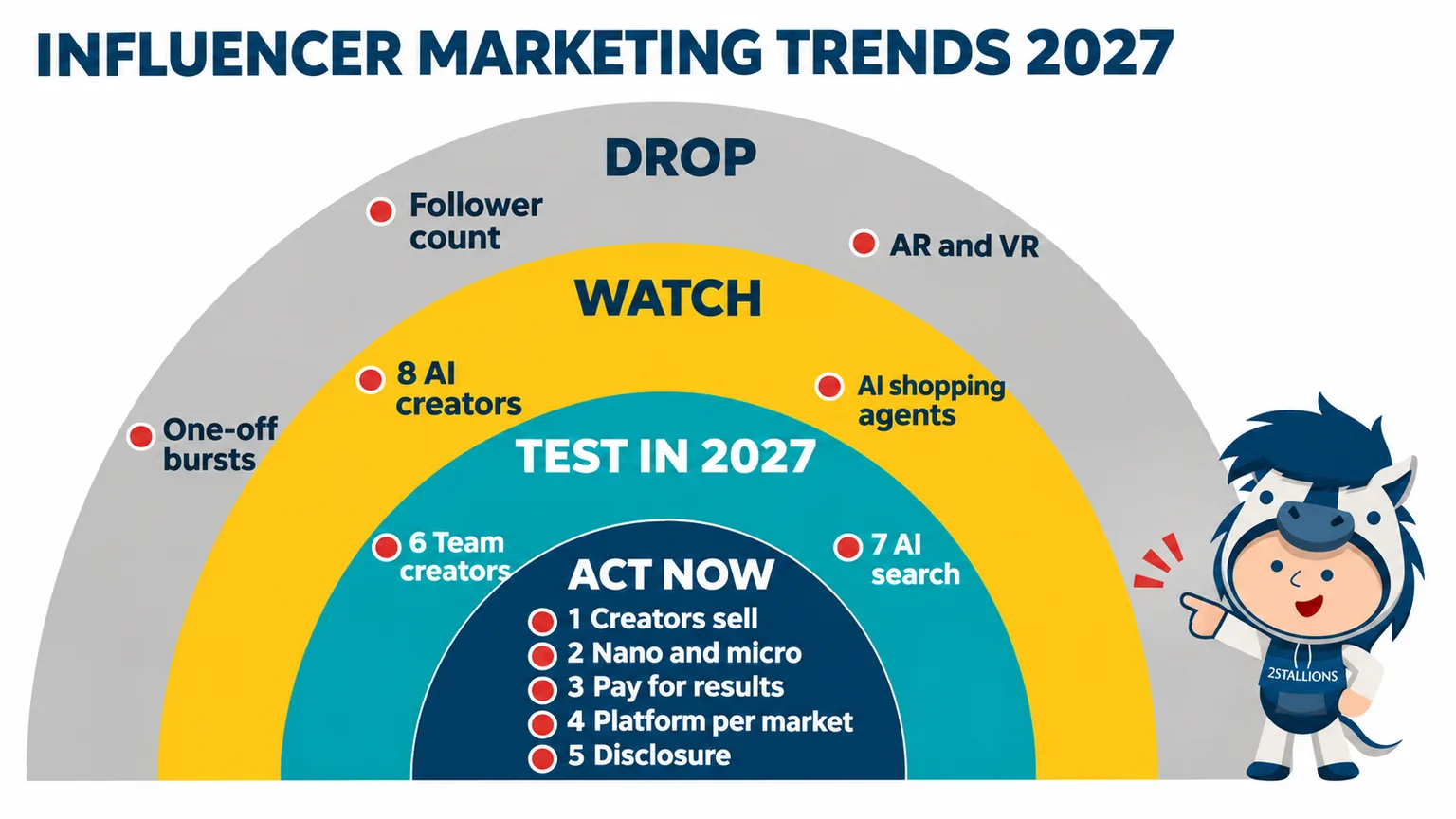
The 2027 influencer marketing trend radar
| Ring | What it means | Trends in this ring |
|---|---|---|
| Act now | 2026 data shows buyers in Southeast Asia already behave this way, or budgets have already moved. Put budget behind it. | 1. Creators become the checkout, 2. Nano and micro creators, 3. Budgets tied to results, 4. Platform mix per market, 5. Disclosure in the contract |
| Test in 2027 | The mechanics exist, but the contracts and the measures are new. Pilot with one success measure. | 6. Team members and experts as creators, 7. Creator content as an AI-search asset |
| Watch | Real, but trust is low | 8. AI creators and AI live hosts; AI shopping agents that complete the purchase |
| Drop | The 2026 data says it no longer earns its line | Buying on follower count; AR and VR as an influencer format; one-off campaign bursts |
If you can only fund two this year, start with trend 1 (one affiliate or live programme on the platform your buyers already shop on) and trend 2 (a cluster of nano and micro creators chosen on engagement). Both tie spend to a sale, and neither needs a large budget to start. The 2Stallions digital marketing trends for 2027 covers creators as one of ten trends. This post goes deeper on the eight that matter in Singapore and Malaysia.
The 8 influencer marketing trends for 2027
1. Creators become the checkout
In Southeast Asia, content commerce is now an estimated 37% of platform e-commerce GMV, up from 20% two years ago[1].
What to do
Pick the platform your buyers already shop on, run one affiliate or live programme with a revenue measure, and read the sales report before the engagement report. 2Stallions is a TikTok Marketing Partner and runs campaigns for clients on the platform; our social media marketing (SMM) service includes creator campaigns.
How big is creator-led commerce in Southeast Asia?
Large, and growing fast. Combined content commerce GMV across Shopee, TikTok Shop and Lazada was US$49.7 billion in 2025, up 98% on the year before[3]. The first half of 2026 brought US$33.8 billion, which puts the year on track for US$77.9 billion[1].
During TikTok Shop’s 6.6 sale in June 2026, reported from Singapore, affiliate creators generated twice the number of sales of an average day, and platform livestream GMV doubled compared with the 2025 sale[4]. Those are the platform’s own figures from its own sale, so read them as a signal of direction.
Do affiliate links cost a creator trust?
Not much. In impact.com’s 2026 Southeast Asia report, only 8% of consumers trust creator recommendations less when affiliate links are present[5]. A clear, labelled link is the safe choice.
What does a live or affiliate programme need to start?
A host. In Malaysia, only about 5% of the creators who answered the question say they can host live streams, in SushiVid’s analysis of 41,039 creator profiles[6]. Hosts who can hold a room for an hour are the scarce input. Book them before you book the stock.
Who should act on this?
Consumer brands that already sell on Shopee, Lazada or TikTok Shop, and any brand with a product that shows well on camera. One limit: a live programme needs stock, a host and a sales report in the same week, so start with one product line.
2. Nano and micro creators, chosen on engagement
In Malaysia, a nano creator’s median Instagram engagement rate is 3.08%, against 0.85% for creators with over a million followers[6].
What to do
Brief ten small creators in one niche instead of one large one, and compare the median engagement of the cluster after a month. Pick each creator on three numbers you can check yourself: engagement on their last ten posts, the share of their audience in your market, and whether their comments come from real people. See the 2Stallions social media trends for the platform side.
Do smaller creators still out-perform big ones?
On engagement, yes. SushiVid’s October 2026 benchmarks put the median nano creator (1,000 to 9,999 followers) at 3.08% on Instagram and 8.95% on TikTok, against 0.85% and 3.90% for creators with over a million followers[6]. Nano creators are 40% of the Instagram creators with 1,000 or more followers in that database[6].
The spread inside a tier is wide, so pick each creator on their own numbers.
Does follower count matter to buyers?
Less than it matters to brands. Only 17% of consumers check a creator’s follower count before deciding to engage, in Sprout Social’s survey of 2,250 consumers in the US, the UK and Australia[7]. No Singapore or Malaysia figure is in that survey, so ask each creator for the share of their followers in your market.
What does a nano creator cost in Malaysia?
An average asking rate of RM434 for one round of content (an Instagram Reel and a TikTok post) at 1,000 to 9,999 followers, rising to RM5,364 at 150,000 to 299,999 followers[6]. SushiVid notes these are asking rates and that negotiated prices are often lower[6].
We ran micro-influencer campaigns on Instagram and TikTok for a jewellery client in Singapore and Malaysia, producing briefs for creators to drive awareness and walk-ins to the physical locations.
Who should act on this?
Any brand with a niche audience and a physical or online place to send people. One limit: ten small creators need ten briefs and ten sets of content to approve, so the saving is in media cost. Your team’s time stays the same.

3. Budgets tied to results
Outcome-driven campaigns reached 42.47% of tracked influencer activity across ten Asia-Pacific markets in 2025, up from 28.24% in 2023[8].
What to do
Name the result in the next brief (orders, leads, affiliate sales) and tie part of the fee to it. For the measurement side, see the 2Stallions guide to influencer marketing analytics.
How many campaigns are paid on results now?
More than two in five across the region. AnyMind’s data from nearly 7,000 campaigns and more than 1.1 million influencers shows outcome-driven campaigns at 42.47% of tracked activity in 2025, from 30.67% in 2024 and 28.24% in 2023[8]. The same data maker reports growing use of Cost Per Result models, where influencer budgets are tied to specific campaign outcomes[9].
Where is the shift furthest along?
Indonesia. There, 74% of campaigns are now designed with performance outcomes in mind[9]. Malaysia is the other way round: awareness-driven campaigns are still 70% of influencer activity, and performance-driven campaigns closed 2025 at 30%, up from 21% in 2024[10].
Who should act on this?
Brands with a tracked checkout or lead form, so the result can be counted. The figures are one platform’s campaigns, so a result-based deal still needs a result your own tracking can count.

4. The platform mix is set per market
Instagram still takes 71% of influencer campaign investment in Singapore, while Malaysian brands split their budgets between Instagram at 48% and TikTok at 44%[9].
What to do
Set the platform split per country from your own campaign data. The influencer marketing trends in Asia you read about are often an average of very different markets.
Which platform leads influencer campaigns in Singapore and Malaysia?
Instagram in Singapore, at 71% of campaign investment[9]. In Malaysia it is close to even: Instagram 48%, TikTok 44%[9]. TikTok’s Malaysian share rose from 8% of campaigns in 2023 to 44% in 2025[10].
How fast did TikTok take share across Southeast Asia?
Fast. Influencer campaigns on TikTok rose from 28.35% in 2023 to 50.58% in 2025[9]. Thailand is at 66% of campaign usage and the Philippines at 64% of campaign volume. In Vietnam, TikTok and Facebook together account for more than 90% of influencer campaign activity[9].
Where does Xiaohongshu fit?
At the research stage, for Mandarin-speaking buyers in Singapore and Malaysia. In Malaysia it already captures over 28% of campaign spend in the Lifestyle and Home category, and over 7% of official brand influencer campaigns overall[10].
Who should act on this?
Regional marketing managers who run one brief across markets. One limit: these are one platform’s campaign shares. Check them against your own account data before you move budget.

5. Disclosure moves from a hashtag to a contract
In Singapore, paid reviews, testimonials and endorsements have to be clearly indicated under the Advertising Standards Authority of Singapore (ASAS) guidelines[11].
What to do
Add three clauses to every creator contract: the disclosure label, the line on AI use, and who approves claims about the product.
Are the disclosure rules tightening?
Yes. In Singapore, the ASAS guidelines already ask for paid relationships to be disclosed prominently[11]. In Malaysia, the Communications and Multimedia Content Forum put draft guidelines for influencers and brand collaborations to public consultation in September 2026[12]. Its chief executive, Mediha Mahmood, put it plainly: “Influencer marketing has become too important to be governed by guesswork.”[12]
Where do you check the rules for your own country?
At the source, because the rules differ by country and by product. In Singapore, start with the Advertising Standards Authority of Singapore, and with the Monetary Authority of Singapore if you sell financial products. In Malaysia, start with the Communications and Multimedia Content Forum.
Who should act on this?
Every brand that pays creators. One limit: the Malaysian guidelines were a draft at the time of writing, and a lawyer should read the contract.
6. Your own team members and experts reach business buyers
82% of business-to-business (B2B) marketers say creators increase credibility with decision-makers, in a YouGov survey of 1,299 B2B marketers for LinkedIn[13].
What to do
Pick two team members who already know the product and have them post one short video a week from their own accounts, with a written rule on claims. The old idea of a brand ambassador is back, with the ambassador on the payroll. For the platform side, see our LinkedIn marketing service and the 2Stallions guide to influencer marketing for B2B brands.
Do creators work for B2B?
Yes, late in the purchase. 56% of B2B buyers depend on creator input in the last stage of the buying process. And 70% of marketers say buyers rely more on peer voices and experts than on brand-produced content[13]. The survey covers marketers in the US, the UK, France, Germany and India. Treat it as direction for Singapore and Malaysia, and pilot before you commit.
Why your own people and experts?
Because credibility is the currency. 83% of B2B marketers say credibility matters more than traditional brand messaging[13]. On the consumer side, 40% of consumers find new products or services each month through posts by a company’s own team members. And 61% believe companies should pay those team members extra for that promotion[7].
Who should act on this?
Professional services, software and education, and any team whose buyers ask a colleague before they ask a brand. One limit: a team member’s audience leaves with them, so build the programme around several voices.

7. Creator content becomes an AI-search asset
B2B brands that connect their creator programme to AI search are nearly twice as likely to be cited in an AI answer: 48% against 26%[14].
What to do
Ask ChatGPT and Gemini your buyers’ five product questions once a month and record whether a creator’s content about you appears. Then brief creators on the questions as well as the product. The 2Stallions guide to search everywhere optimisation (SEO) trends covers the writing side.
Do AI answers cite creator content?
Sometimes, and more often for brands that plan for it. In TopRank Marketing’s survey of more than 400 senior B2B marketers, 86% said AI visibility is important, but only 21% had made it part of their programme[14]. In Southeast Asian e-commerce, creator citations in AI answers are “nascent but on the rise”, and AI recommendations still favour marketplaces and brand-owned websites[15].
How many Southeast Asian shoppers ask an AI before they buy?
It depends on the question asked. One in four, 24%, use generative AI tools such as ChatGPT and Gemini to support shopping decisions, in a survey of 2,400 consumers across six markets[16]. The same report’s own summary says over half of Southeast Asian consumers already use AI while shopping[5]. Use of AI for product discovery runs from 34% in Vietnam and 31% in Indonesia to 14% in Singapore[16].
Trust is split. 38% trust creators and AI equally, 36% trust creators more, and 25% lean towards AI[16].
Who should act on this?
Brands that already track whether AI answers name them. One limit: the 48% figure is what marketers reported in TopRank’s survey, so read it as a link between the two[14].

8. AI creators and AI live hosts
In Sprout Social’s 2026 survey of 2,250 consumers in the US, the UK and Australia, 44% expressed discomfort with brands using AI influencers[7].
What to do first: nothing to fund yet. Write the AI-use line into creator contracts (trend 5), and test an AI live host only on a product where trust is low stakes.
Do buyers accept AI influencers?
Most do not, yet. In Singapore, 26% of respondents were willing to engage with AI-generated digital influencers[17]. In the US, the UK and Australia, nearly half of consumers, 44%, express discomfort with brands using AI influencers[7].
Where is Southeast Asia different?
Indonesia. In a YouGov survey, nearly 50% of Indonesian respondents were willing to engage with AI-generated digital influencers. The global average was 23%, with 40% in Hong Kong and 26% in Singapore[17]. In the same survey, 78% said it is important that brands clearly disclose when AI is used in content[17].
What do AI live hosts cost?
A fraction. Momentum Works reports that AI livestreaming costs around 20 to 25% of a comparable human operation and generates around 80% of human livestream GMV per hour[1]. Malaysia’s draft guidelines add a rule: AI and virtual influencers should not claim personal experiences they could not have had[12].
Who should act on this?
Brands selling in Indonesia may test. Brands selling in Singapore should watch, because an AI host cannot vouch for a product it has never used, and your buyers know it.
Watch and drop
- Watch: AI shopping agents that buy. One forecast says that by the end of 2027, one in five Southeast Asian online shoppers will complete a purchase natively through a generative AI platform[16]. It is a forecast. If it holds, a creator’s review becomes an input to an agent, which is one more reason to get cited (trend 7).
- Drop: buying on follower count. Only 17% of consumers check it[7], and the engagement data in trend 2 runs the other way.
- Drop: AR and VR as an influencer format. The last version of this article put immersive technology at the centre of 2025. Nothing in the 2026 data above puts it among the trends brands fund. Keep it for product demos where it earns its cost.
- Drop: one-off campaign bursts. AnyMind’s advice for Malaysia is to treat creator partnerships as an always-on strategic investment[10]. Creators agree: in Vero’s white paper on Southeast Asian influencers, published December 2024, 86% of brand partnerships were structured on a per-project basis, and 29% cited long-term partnership opportunities as a major consideration[18]. Book the second and third posts in the first contract, and let the creator write the script.
How to act on these trends in 2027
- Set the platform split per country from your own campaign data.
- Replace one large creator with a cluster of nano and micro creators, and compare median engagement after a month.
- Rewrite the contract: a base fee plus a per-result bonus, the disclosure label, the AI-use line, and who approves claims.
- Run one affiliate or live programme with a revenue measure on the platform your buyers already shop on.
- Add two measures next to reach: whether AI answers cite creator content about you, and what your own team members’ posts reach.
If you want help building this, our social media marketing (SMM) service runs creator campaigns across Singapore, Malaysia, Indonesia and India.
More 2027 trend reports
This guide is part of our 2027 trends series. Start with the digital marketing trends for 2027, or pick another guide below.
Content trends
Branding trends
Social media trends
SEO trends
Digital advertising trends
Google Ads trends
Web design trends
Frequently asked questions
What are the influencer marketing trends for 2027?
On this radar: creators become the checkout, nano and micro creators chosen on engagement, budgets tied to results, a platform mix set per market, and disclosure written into contracts. Your own team members as creators and creator content as an AI-search asset are the two to test. AI creators are the one to watch.
What is the future of influencer marketing?
Closer to the sale. In Southeast Asia, content commerce is an estimated 37% of platform e-commerce GMV[1], and a growing share of campaigns is paid on results. The creator’s job shifts from awareness to the last step before a purchase, while AI content makes a trusted human voice more valuable.
What are the influencer marketing trends in Asia?
They differ by market. Instagram leads campaign investment in Singapore at 71%. Malaysia splits Instagram and TikTok almost evenly. TikTok leads in Thailand and the Philippines, and TikTok and Facebook together carry over 90% of campaigns in Vietnam[9]. Indonesia is the furthest along on performance-based campaigns.
Do influencers in Singapore and Malaysia have to disclose paid posts?
In Singapore, yes: the ASAS guidelines require paid reviews and endorsements to be clearly indicated. In Malaysia, the Content Forum’s draft influencer guidelines went to public consultation in September 2026. Check the current rules with the Advertising Standards Authority of Singapore or the Communications and Multimedia Content Forum, and ask a lawyer before you sign a creator contract.
Will AI influencers replace human creators?
Not in 2027. In Sprout Social’s 2026 consumer survey, 44% expressed discomfort with brands using AI influencers[7], and Singapore shoppers are among the least willing to engage with them. AI live hosts are cheap to run, so expect them on low-trust products first.
Sources
All sources were retrieved on 11 November 2026.
- Momentum Works (The Low Down): New report: Southeast Asia’s content commerce on track to reach US$77.9 billion in 2026
- Gartner: Gartner Marketing Survey Finds 35% of Consumers Rely on Influencers Less Due to AI
- TechNode Global: Southeast Asia content commerce to reach US$77.9 billion in 2026 as live goes mainstream
- TikTok Newsroom: TikTok Shop celebrates its largest 6.6 Birthday Mega Sale
- impact.com: E-commerce Influencer and Affiliate Marketing in Southeast Asia 2026
- SushiVid: State of Influencer Marketing in Malaysia 2026
- Sprout Social: The 2026 Influencer Marketing Report
- AnyMind Group: AnyMind Group releases State of Influence in APAC 2026 Report
- AnyMind Group: The New Rules of Influencer Marketing in Southeast Asia
- AnyMind Group: AnyMind Group releases Influencer Marketing in Malaysia 2026 Report
- Advertising Standards Authority of Singapore: ASAS Issues Guidelines for Interactive Marketing Communication & Social Media
- The Star: New guidelines for influencers to cover AI-generated content, child exploitation and fake claims, says Content Forum
- LinkedIn: LinkedIn Creator Marketplace and BrandWorks for connecting brands with creators and driving business impact
- TopRank Marketing: The 2027 B2B Influencer and Creator Marketing Report
- Cube: E-commerce Influencer Marketing in Southeast Asia 2026
- Marketing-Interactive: AI is changing how SEA shops, but trust still wins the checkout
- Marketing-Interactive: Study: Indonesians twice as likely to interact with AI influencers than global average
- Vero: Impact, Engagement, and the Future of Influencer Marketing in Southeast Asia