


This month we asked four AI assistants the questions our own buyers ask about agencies in Singapore. Our name came up in a minority of the answers. The shortlist those assistants gave was decided before any buyer had opened a single website.
That is now a normal way to look for a supplier. The Reuters Institute’s Digital News Report 2026 found that one in 10 people use AI chatbots for news, up from 7% a year earlier. Trust in their answers sits at 20% globally[1].
Most lists about the future of branding rank visual styles. This one ranks six trends by one question: does it change whether a buyer, or the AI the buyer asks, picks you? Four are ready to act on now, and two are worth a test in 2027.
If you can only fund two, start by counting how often AI assistants name you and by collecting proof from other people. Below is the radar, what to do first for each trend, and then the dated evidence.
Why branding changes in 2027: buyers now ask an AI
Buyers now ask AI assistants first, and Gartner’s VP Analyst Julie Reeves put the consequence in one sentence in June 2026: “In an AI-driven market, brand clarity becomes even more critical”[2].
AI raises the floor for everyone, so the human layer decides who wins. Our digital marketing trends for 2027 post makes the same case for AI answers and for brand building.
The 2027 branding trend radar
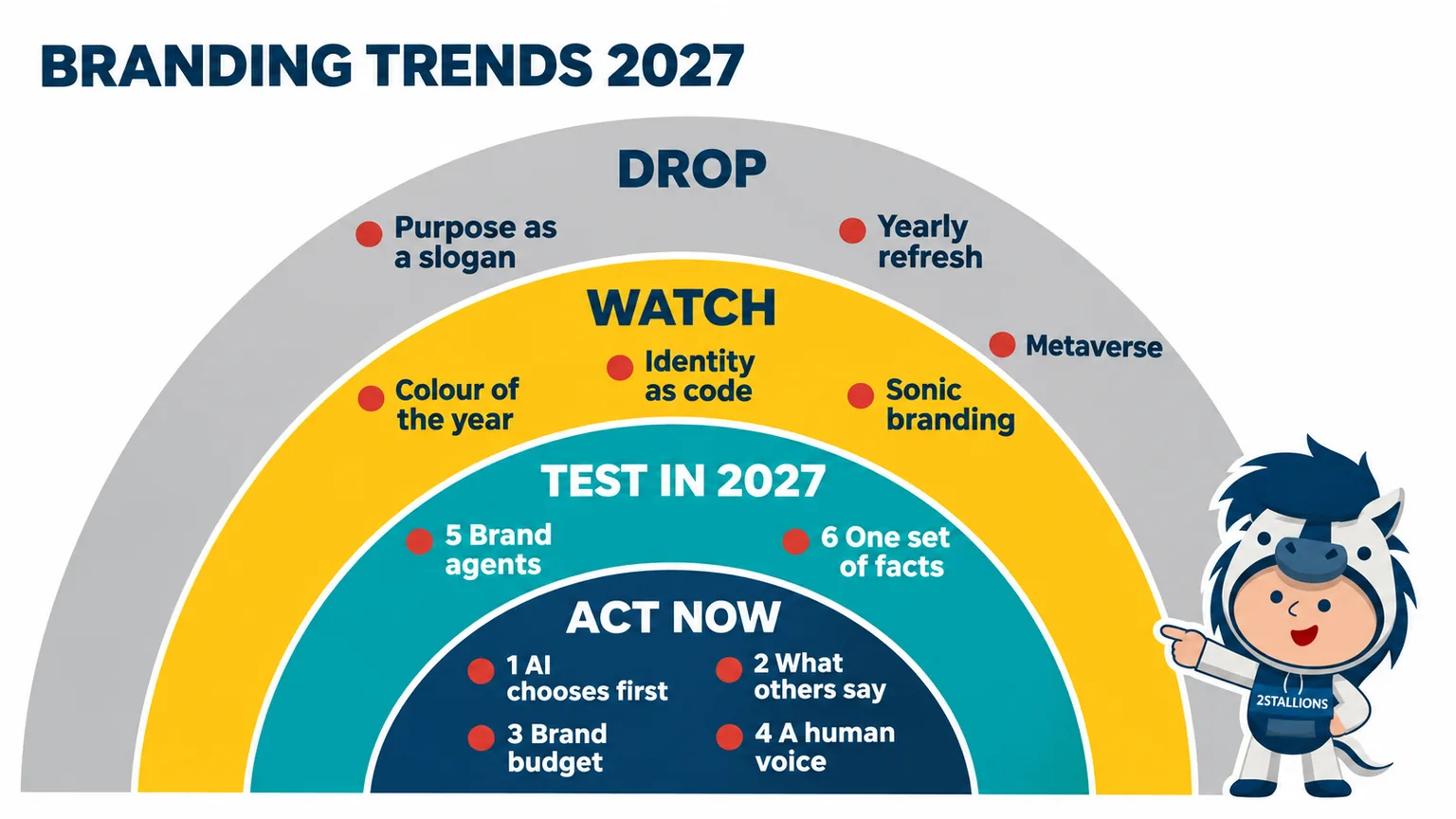
| Ring | What it means | Trends in this ring |
|---|---|---|
| Act now | 2026 data shows buyers or budgets already moving. Put budget behind it. | 1. AI chooses first, 2. What others say, 3. Brand budget, 4. A human voice |
| Test in 2027 | Live products exist, but few brands rely on them yet | 5. Brand agents, 6. One set of facts |
| Watch | Real, but not ready for most budgets | Colour of the year; identity systems as code; sonic branding |
| Drop | Stop planning around it as a trend | Purpose as a slogan; a visual refresh every year; the metaverse as a brand play |
A trend sits in Act now when 2026 data shows buyers already behave this way or marketers are already moving budget to it. It sits in Test when the products are live but few brands rely on them.
If you can only fund two this year, start with trend 1 (count how often AI assistants name you) and trend 2 (collect proof from other people). Both cost time before they cost money.
The 6 branding trends for 2027
The order follows one rule: does the trend change whether a buyer, or the AI the buyer asks, chooses you?
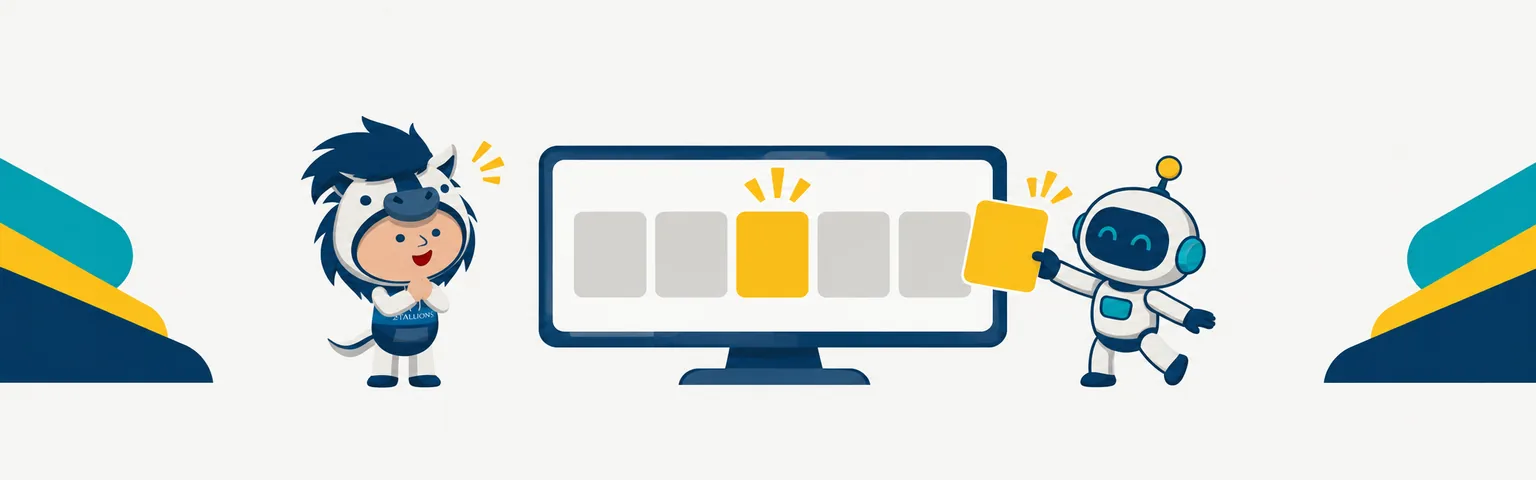
1. An AI often chooses your brand before a person does
In Accenture’s January 2026 survey, 37% of the consumers it classes as behaviourally loyal said they would let an AI agent switch brands for a better fit[3].
What to do
Write down the 20 questions your buyers ask before they call you. Put them to ChatGPT, Gemini, Claude and Perplexity, and count how often your brand is named.
Then open the new reports. Google Search Console has a separate view for visibility in AI Overviews and AI Mode, by page, country and date[4]. Bing Webmaster Tools shows how many times AI answers cited your pages and the key phrases the AI used[5].
Our guide to search everywhere optimisation (SEO) trends covers how to write for those answers.
Do buyers already let AI choose for them?
Some do, and more say they would. One in three consumers (32%) are ready to hand over purchase decisions to an agent[3]. The executives who sell to them have read the same signals: in Deloitte’s 2026 US retail outlook, 81% of retail executives expect generative AI to weaken brand loyalty by 2027[6].
What did we see when we asked the AIs ourselves?
We ran the questions our buyers ask about agencies in Singapore through ChatGPT, Gemini, Claude and Perplexity, and counted how often each answer named us. Our name appeared in a minority of them, and far more often in some assistants than in others. Google’s own report adds a second fact. Our pages appear in its AI features many times a month, and very few of those appearances turn into a visit. The count gave us a list of questions where the answer should be us and is not yet.
What does Google say you need?
Nothing special. Google says there are “no additional requirements to appear in AI Overviews or AI Mode, nor other special optimizations necessary,” and asks that your structured data match the visible text on the page and that your Business Profile stays up to date[7]. The work is the same work: clear answers and facts with dates, under a named person.
Who should act on this?
Any brand whose buyers research before they call. In business-to-business (B2B), that is almost all of them. The Reuters figures measure news habits only, and they cover Singapore: 11% of people there use AI chatbots for news, close to the global 10%[8].
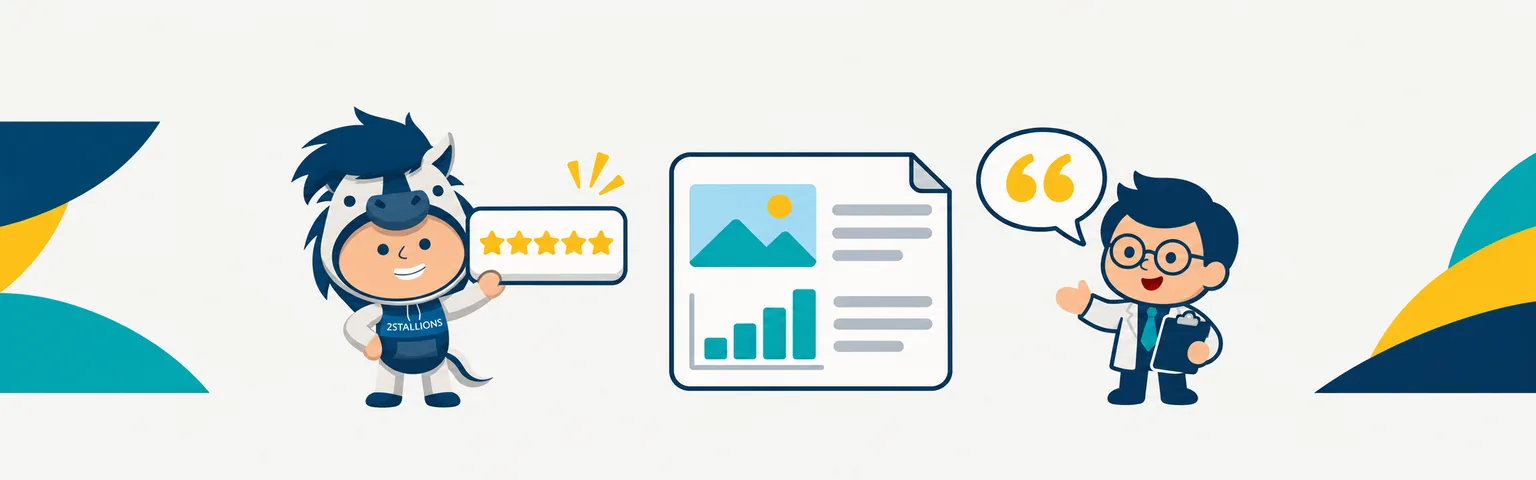
2. What others say about you outweighs what you say
Edelman’s 2026 brand report puts it plainly: globally, when it comes to building trust, what others who are not paid by the brand say about it matters far more than what the brand says about itself[9].
What to do
Collect three kinds of proof this quarter. Client reviews with names, where the client allows it. One case study with a number and a date. One expert or creator who says what you do in their own words. Put all three where a buyer and an AI will find them.
Our guides to social media trends and influencer marketing trends cover the channels.
Does paying for influence still work?
It costs more than it buys. In a Harris Poll survey of 2,180 adults in the United States for Quad, 75% said they would trust a brand less if it paid to influence AI agents, and the same share would trust the AI agent less[10].
Creator budgets keep rising, with a net 61% of marketers planning to increase creator investment in 2026, yet Kantar found only 27% of creator content ties strongly to the brand[11]. Money buys reach. Trust still comes from someone who was not paid.
What counts as proof?
A result with a number, a date and a named person behind it. In Canada, Ipsos found 61% of people would try a brand an AI suggested, against 90% who would try a brand a trusted person recommended[12]. The trusted person wins by a wide margin. Those are Canadian figures. For Singapore or Malaysia, read the size of the gap and leave the exact numbers.
One of our own examples sits on this site. A new instant noodle brand in Malaysia had to earn attention and trust in a category where the established players are strong.
Over 12 months the launch reached 6.2 million Facebook impressions, 83.4 thousand Facebook engagements, 8.1 thousand new followers and 1.3 million Instagram impressions. The case study reports awareness and community figures only, with no sales data. Its own closing line is the point of this trend: contests and user-generated content create reach that paid ads alone do not.
Who should act on this?
Firms whose buyers choose on trust: professional services, healthcare, education, and anyone selling a first purchase to a stranger. The Quad and Harris Poll figures are from the United States only, so take them as a direction for buyers in Singapore and Malaysia.
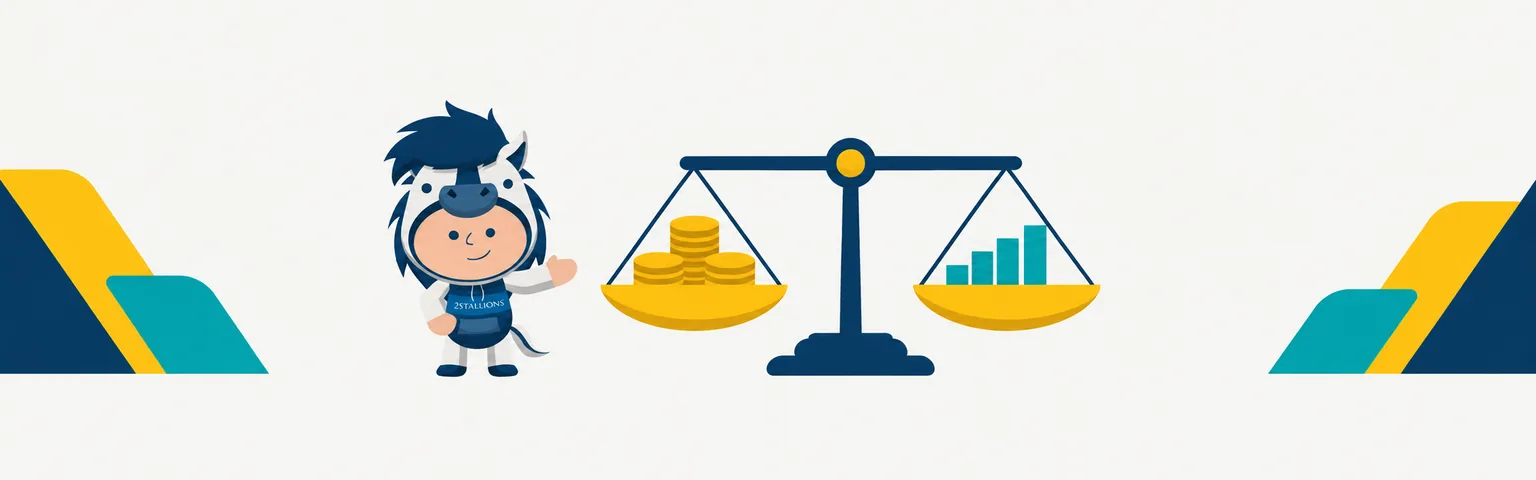
3. Brand budget has to prove itself or lose its seat
Gartner’s survey of 426 senior marketing leaders found 84% of companies stuck in a “brand doom loop”[2].
What to do
Set a brand budget line and protect it. Start from the split the Institute of Practitioners in Advertising (IPA) found across its awards dataset, just over 60% on brand building and a little under 40% on activation[14].
Then report three brand measures every quarter next to leads: branded searches, direct traffic, and how often AI answers name you (trend 1).
The hub post’s section on brand building explains the split; our guide to measuring brand awareness covers the measures.
What is the brand doom loop?
A company underinvests in brand measurement, so it lacks confidence in the results, so brand attracts even less funding[2]. Companies caught in it were half as likely to exceed their growth targets, and Gartner predicts that by 2027 over 40% of chief marketing officers (CMOs) who push for larger brand budgets will lose influence with the C-suite because they cannot show the return[13].
Gartner’s analyst Julie Reeves describes the result as a cycle where brand is “undermeasured, underfunded and undervalued”[2]. The brand line fails because it has no number next to it.
How much should go to brand building?
The IPA’s most recent analysis says just over 60% on brand building and a little under 40% on activation, meaning the advertising that drives an immediate sale[14]. Treat it as a starting point, then move it with your own measures.
Who should act on this?
Any marketing lead who has to defend a brand line in front of a CEO or a finance director. The IPA figure comes from its Effectiveness Awards dataset. Southeast Asia may differ, so test the split against your own numbers.

4. A human voice is the thing AI cannot copy
Forrester predicts that in 2027 human-generated content “will become a top priority again for 50% of brands”[15].
What to do
Write down the three things your brand says that no rival would say the same way. Name the people who speak for the brand. Put a person’s name on every important piece, and let that person’s own words stay in it.
Our guide to content marketing trends shows what proof of a real person looks like in practice.
Why does a human voice matter more now?
Readers have made their own judgement. Trust in answers from AI chatbots is 20% globally, against 37% for news overall[1].
Marketers have reached the same view from the other side: HubSpot’s 2026 survey of more than 1,500 marketers found 62.7% believe more unique, human-centred content is needed to compete with AI content[16]. Kantar’s 2026 BrandZ report agrees: standing out as meaningful and different has become more important for brands[17].
What goes wrong when AI speaks for the brand?
The marketers running it expect trouble. Forrester found 64% of business-to-consumer (B2C) marketing executives in the United States believe their use of AI is likely to produce a brand-damaging incident within the next 12 months[18].
The brands that fare best will be the ones that test AI experiences before launch, in Forrester’s words. The survey is of US executives, so for a Singapore or Malaysia brand it shows the direction of risk only. Keep a named person responsible for what the brand says in public.
Who should act on this?
Every brand that publishes.

5. Your brand gets its own agent
Microsoft’s Brand Agents, “AI-powered shopping assistants that speak in your brand’s voice,” were available to Shopify merchants when Microsoft announced them on 8 January 2026[19].
What to do
Write your brand’s plain-text answers to its 20 most common buyer questions, the same 20 from trend 1, and publish them on a page of your site. Then pilot one agent on one task, with one named owner and a written rule for what it may not say.
Will people trust a brand’s own agent?
More than they trust a platform’s. In Accenture’s survey, consumers are more than twice as likely to trust brand- or retailer-owned agents as AI-native platform agents[3]. Forrester’s 2027 predictions say that brands which prioritise trust over automation will be best positioned to capitalise on agentic commerce[20].
Why test before a full roll-out?
Because the share is still small. Forrester predicts one in 20 consumers in the United States and the United Kingdom will abandon traditional shopping for conversations[20]. Copilot Checkout itself is only beginning to roll out, in the U.S. on Copilot.com[19]. A pilot teaches you what an agent gets wrong about your brand while the audience is still small.
Who should act on this?
Brands with a product catalogue, or a steady stream of the same questions from buyers. An agent repeats a wrong brand fact at scale until someone notices, so trend 6 comes first.
The Forrester figure covers the United States and the United Kingdom and Copilot Checkout starts in the U.S., so in Singapore or Malaysia this is a pilot to plan for now.
6. Digital branding becomes one set of facts that machines read
Google says no additional requirements or special optimisations are needed to appear in its AI features, but it does ask that structured data match the visible text and that Merchant Center and Business Profile information is up to date[7].
What to do
Audit the brand facts a machine can read about you. Your name, what you do, where, for whom, and your prices where they are public. Check them across your site, Google Business Profile, LinkedIn, directories and partner pages, and make them match. Then check the identity itself at feed size and in plain text.
Our branding design service and brand guidelines work both ends, and the guide to brand identity and brand image explains the difference.
What are the digital branding trends for 2027?
The first is one set of brand facts that reads the same on every site and profile. The second is an identity system that works at the size of a phone screen and in text alone, because an AI answer carries no logo. The third is the new visibility reports from Google[4] and Bing[5], which show you what the machines picked up.
Is a new logo part of this?
No. Kantar found that standing out as meaningful and different now matters more for brands[17]. In an AI answer that difference shows up in the claims and the proof behind them, because the answer carries no logo. A new mark on the same unverifiable claims changes nothing an AI can read.
Who should act on this?
Brands with more than one office, site or listing. Most brands that sell in both Singapore and Malaysia fit that.
Watch and drop
- Watch: colour of the year. WGSN and Coloro named Luminous Blue the Colour of the Year for 2027, alongside interconnectedness as the theme for their 2027 key colours[21]. Use it if it fits your system, and skip it if it does not.
- Watch: identity systems as code. Design tokens and variable fonts help teams that ship to many screens. Worth a look once your brand facts (trend 6) are in order.
- Watch: sonic branding. A sound mark matters more as more brand moments happen with no screen. Fund it when you have the channels for it.
- Drop: purpose as a slogan. What unpaid others say about you matters far more than what you say about yourself[9]. A purpose statement with no proof behind it is a claim like any other.
- Drop: a visual refresh every year. Change the identity when the strategy changes, and leave it alone when the calendar changes.
- Drop: the metaverse as a brand play. The hub post’s Watch and drop explains why.
How to act on these trends in 2027
- Count how often four AI assistants name you for your buyers’ questions, and read the AI visibility reports in Google Search Console and Bing Webmaster Tools.
- Collect three kinds of proof from other people this quarter: named reviews, one dated case study, one expert or creator in their own words.
- Set a brand budget line and three brand measures, and report them next to leads every quarter.
- Name the people who speak for the brand, and put their names on the work.
- Audit your brand facts everywhere a machine reads them, then pilot one brand agent with one owner.
If you want help with the system behind all five, our branding design service works with brands in Singapore and Malaysia, and our teams in Singapore, Malaysia, India and Indonesia carry the work across the region.
An AI assistant will describe your brand to a buyer tomorrow. Give it something true to go on.
More 2027 trend reports
This guide is part of our 2027 trends series. Start with the digital marketing trends for 2027, or pick another guide below.
Content trends
Social media trends
SEO trends
Influencer marketing trends
Digital advertising trends
Google Ads trends
Web design trends
Frequently asked questions
What are the branding trends for 2027?
Four to act on now: being named in AI answers, proof from other people, a brand budget that reports its own return, and a human voice that AI cannot copy. Two to test: a brand-owned agent, and one set of brand facts that machines read the same way everywhere. Colour of the year and identity styles stay in Watch.
What is the future of branding?
A brand will be chosen more often by an AI acting for a buyer, and judged on what others say about it and on facts a machine can verify. The parts that still decide the outcome are human: trust and a recognisable voice, backed by proof from real people.
What are the digital branding trends for 2027?
One set of brand facts that reads the same on every site and profile, an identity system that works at phone-screen size and in plain text, and the new AI visibility reports in Google Search Console and Bing Webmaster Tools.
How do I know if AI answers mention my brand?
Ask the assistants your buyers’ questions and count. Then open Google Search Console’s generative AI view, which shows which of your pages appeared in AI Overviews and AI Mode, and Bing Webmaster Tools’ AI Performance report, which counts citations and the key phrases the AI used.
How much of the marketing budget should go to brand building?
The IPA’s analysis of its awards dataset puts the best split at just over 60% on brand building and a little under 40% on activation. Start there and adjust with your own measures.
Sources
All sources were retrieved on 11 November 2026.
- Reuters Institute for the Study of Journalism: Digital News Report 2026, overview and key findings
- Gartner: Gartner Marketing Survey Finds 84% of Companies Are Stuck in a “Brand Doom Loop”
- Accenture: Consumer Pulse Research 2026, The new rules of brand value
- Google Search Central: Generative AI performance reports
- Microsoft Bing: Introducing AI Performance in Bing Webmaster Tools
- Deloitte: 2026 US Retail Industry Outlook
- Google Search Central: AI features and your website
- Reuters Institute for the Study of Journalism: Digital News Report 2026, Singapore
- Edelman: 2026 Edelman Trust Barometer Special Report: Brand Growth in an Insular World
- Quad with The Harris Poll: The New Rules of Retail Trust in the Age of AI
- Kantar: Kantar’s 2026 marketing trends
- Ipsos: AI can shop for you. But will consumers let it?
- Gartner: Gartner Predicts Over 40% of CMOs Who Push for Larger Brand Budgets Will Lose Influence With the C-Suite
- The Institute of Practitioners in Advertising (IPA): Eggs in two baskets
- Forrester: Predictions 2027: Humans Reclaim Content Creation; Machines Dominate Content Consumption
- HubSpot: 2026 State of Marketing
- Kantar: Revealed: the world’s most valuable global brands in 2026
- Forrester: Predictions 2027: CMOs Reckon With An AI Reality Check
- Microsoft Advertising: Conversations that convert: Copilot Checkout and Brand Agents
- Forrester: Forrester’s 2027 B2C Marketing, CX, And Digital Predictions
- WGSN: WGSN and Coloro reveal Colour of the Year 2027, Luminous Blue