

AI has made every brand’s social output cheap. In 2027 the edge goes to the brands that people find inside the apps, that reply fast and that show a real person.
The 10 trends below are ranked by what buyers in Singapore, Malaysia and Indonesia already do. The feed is now the front page. In the 2026 Reuters Institute survey, social and video networks were used for news by 54% of people, ahead of news organisations’ own websites and apps at 51%[1].
Why social media marketing changes in 2027: the feed is the front page, and in Southeast Asia more so
People in Southeast Asia use social apps for news at rates above the global figure: 59% in Singapore[2] and 64% in Indonesia[3]. Output is no longer scarce, so the human layer is what’s left to compete on, and it’s the thread through the trends below. The 2Stallions digital marketing trends for 2027 makes the same case for AI answers.
The 2027 social media trend radar
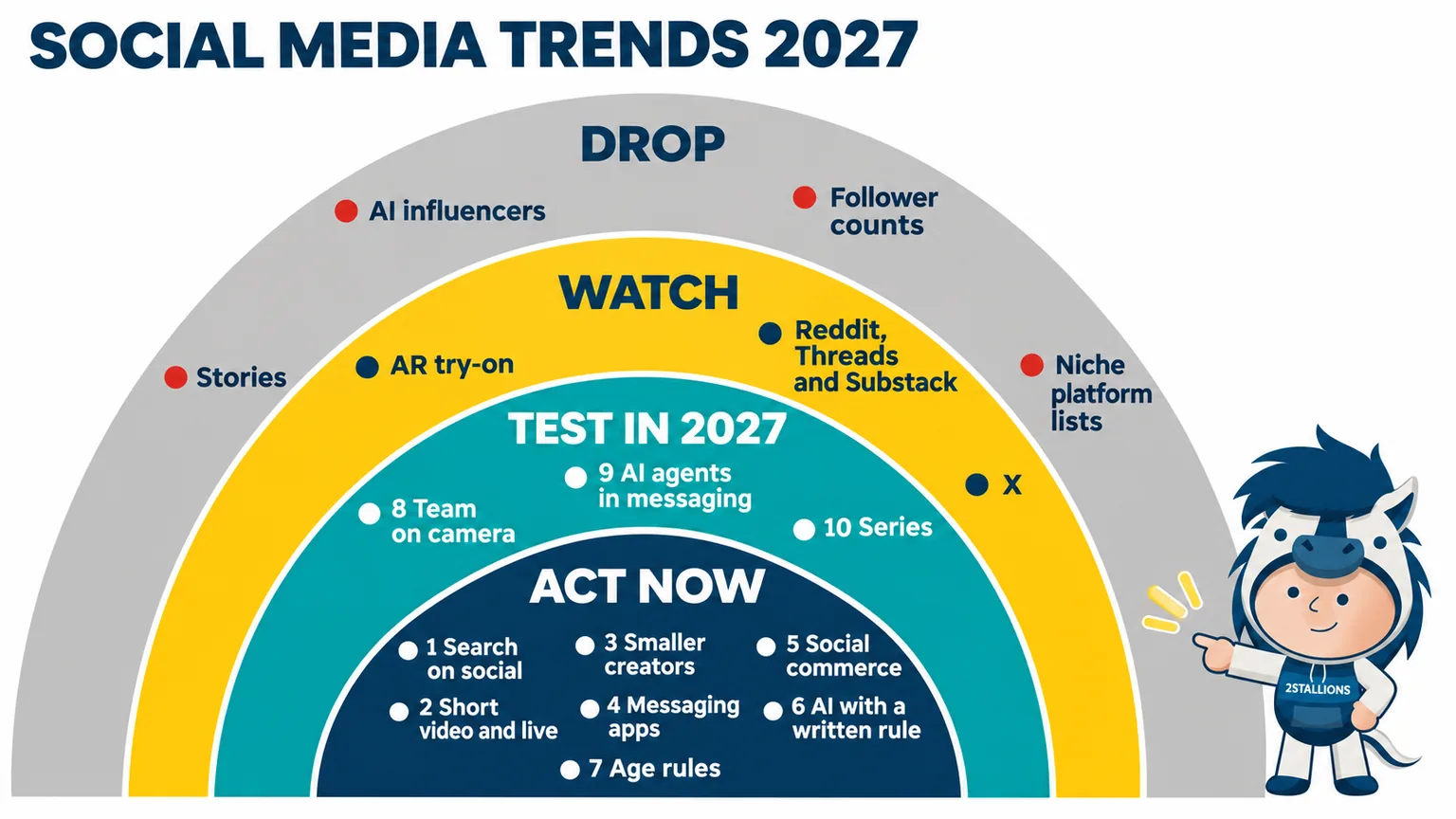
| Ring | What it means | Trends in this ring |
|---|---|---|
| Act now | It works today, with proof. Put budget behind it. | 1. Search on social, 2. Short video and live, 3. Smaller creators, 4. Messaging apps, 5. Social commerce, 6. AI with a written rule, 7. Age rules |
| Test in 2027 | Ready for a pilot with a clear success measure | 8. Team on camera, 9. AI agents in messaging, 10. Series |
| Watch | Real, but not ready for most budgets here | Augmented reality (AR) try-on and virtual experiences; Reddit, Threads and Substack; X |
| Drop | Stop planning around it as a trend | Virtual and AI influencers; follower count as the main measure; Stories as a trend of their own; lists of niche platforms |
A trend is in Act now when 2026 data shows buyers in Singapore, Malaysia and Indonesia already behave this way, or marketers are already moving budget to it, and a team can start without a new budget line. It’s in Test when many teams try it but few can show a result yet.
If you can only fund two this year, start with trend 1 (be the answer inside the apps) and trend 4 (reply fast in WhatsApp). Both cost time, and almost no media budget.
The 10 social media marketing trends for 2027

1. Search starts on social, and AI answers quote what social says
Among Gen Z respondents in the United States, the United Kingdom and Australia, 47% regularly search on TikTok and 41% on Instagram, and 21% of all consumers go to social media first when they search[4].
What to do
Put the question your buyer asks in the first line of the post, the caption and the on-screen text. Answer it in the first sentence.
Then check how AI tools describe your brand. In the Emplifi survey, 48% of marketers already monitor this, and 22% say nobody owns it[5]. The same habit helps your wider search everywhere optimisation (SEO) work.
Do people in Singapore and Malaysia search on social?
Probably, though there’s no regional figure for search itself. The regional data is about news: 59% of people in Singapore use social media for news[2], and nearly seven in 10 in Malaysia[6]. The Sprout sample is 2,250 social media users in the United States, the United Kingdom and Australia[4].
How do I make a post findable?
Write it the way a person would type the question. Use the same words in the caption, the on-screen text and the spoken line. Don’t rely on a clever hook that nobody would search for.
Who should act on this?
Brands whose buyers are under 35.

2. Short-form video stays the default format, and live video grows
Short-form video gave the biggest return of any format for 48.6% of marketers in HubSpot’s 2026 survey of more than 1,500 marketers[7]. In the Emplifi survey, 55% expect short-form video to grow most in their mix[5].
What to do
Run one weekly series on one topic, and cut every talk or webinar into clips. Try one live session a month. For the basics, see creating video content for social media.
Is short video still worth it for a B2B brand?
Yes, as a test. The HubSpot sample covers both business-to-business (B2B) and consumer marketers, so treat the figure as a starting point for a B2B brand[7]. Pick one question your sales team hears every week and answer it on camera in under a minute.
Is live video growing here?
Yes. TikTok Shop Singapore reported LIVE viewership up 150% year on year[8]. Our published case study for a Singapore heritage jeweller used live events, previews of new collections and influencers to reach more than 20 million impressions in 12 months[9].
Who should act on this?
Any brand with someone willing to be on camera every week.

3. Smaller creators with a clearer brief
In the past year, 67% of consumers have made a purchase directly because of an influencer’s recommendation, rising to 81% among Gen Z[4]. Yet only 27% of creator content ties strongly to the brand, according to Kantar[10].
What to do
Brief the one sentence you want said, let the creator say it their way, and read the comments. Tell people it’s a partnership. For more, see our influencer marketing trends.
Do people trust influencers?
They trust everyday people most for product recommendations. Across all demographics, 57% of consumers trust everyday users for product recommendations, 26% trust subject experts and 9% trust mega-influencers[4]. Also, 81% say it matters that the influencer has used the product[4].
Our Singapore jeweller case study used influencers to promote live events and widen awareness among people who had not heard of the brand[9].
Are creator budgets going up?
Yes. In the Emplifi survey, 53% of marketers expect their influencer budget to increase[5].
Kantar found a net 61% of marketers planned to raise creator investment in 2026[10]. Creators also reach people as a news source: 32% of people in Malaysia access content from news-focused creators[11]. Worldwide the figure is 27%[1].
Who should act on this?
Consumer brands and anyone selling to under-35s. One limit: the Sprout sample is from the United States, the United Kingdom and Australia, and Kantar’s release doesn’t describe its sample.

4. Messaging apps carry the relationship
WhatsApp is used for news by 56% of Indonesians, up 13 points[3]. In Malaysia WhatsApp reaches 50%, narrowly ahead of Facebook at 49%[6].
What to do
Put a WhatsApp or Messenger link on every profile and ad, set a reply-time target, and answer in public first when something goes wrong. Our social media marketing (SMM) service covers this.
How fast do people expect a reply?
Fast. In the Sprout survey, 64% of consumers say it’s important for a brand to respond to a crisis publicly on social media, and only 16% say speed doesn’t change how they judge the response[4]. Among Gen Z, the figure is 10%[4].
In our case study for a plastic pipe manufacturer in Asia-Pacific (APAC), we posted on YouTube, Facebook and LinkedIn and replied to comments and messages. Facebook likes rose 4,760%, a rise that the case study itself says implies a very small starting audience, and content reached more than 80,000 people in the target audience on Facebook in six months[12].
Is this only a Southeast Asia habit?
No, but it’s strongest here. Meta says there are more than one billion active threads with businesses on WhatsApp, Messenger and Instagram every day[13].
Who should act on this?
Any brand that sells to people, and B2B brands with a sales team.
5. Social commerce and live selling, where Southeast Asia leads
Content commerce, meaning live selling, short video and content-led affiliates, now accounts for an estimated 37% of Southeast Asia’s platform ecommerce gross merchandise value (GMV), up from 20% two years earlier[14]. Momentum Works says content commerce is on track to reach US$77.9 billion in 2026[14].
What to do
Pick one product, run one live session and work with one affiliate creator. Judge it on orders. If you sell through Instagram, set up its shop tools before you pay for more reach.
Our TikTok marketing service covers the TikTok side, and the shopping trend in our digital marketing trends post covers apps and AI chats.
Does live selling work outside China?
In Singapore, yes. TikTok Shop Singapore reported GMV up 1.7 times and monthly buyers up 1.6 times year on year[8]. The Momentum Works figures cover the whole region[14].
What does it take to run a live?
More people than you would guess. TikTok’s own example is a Singapore seller whose LIVE team grew from one full-time person to more than 10[8].
Who should act on this?
Brands with a product under a few hundred dollars and stock ready to ship.

6. AI makes the output; a written rule decides what goes out
AI increased team output for 90% of marketers, yet 51% use AI tools their company hasn’t approved at least some of the time, and only 37% of organisations have a fully defined AI policy for marketing[5].
What to do
Write the rule on one page. Cover the sources you allow, the tone, what a person signs off, and what is never made by AI: a face, a client quote, a result. Name one owner.
The 2Stallions guide to AI in digital marketing says more.
Do people mind AI content?
Many do. In the Sprout survey, 44% are uncomfortable with brands using AI influencers, and 27% aren’t sure whether the influencers they follow are AI[4]. In HubSpot’s survey, 62.7% of marketers say more unique, human-centred content is needed to compete with AI content[7].
Where does AI pay off on social?
Mostly on the platform side. The combined revenue run-rate of Meta’s video-generation tools reached US$10 billion in the fourth quarter of 2025[15]. In the third quarter of 2026, Meta’s average price per ad rose 14% year on year while ad impressions rose 10% year on year[16].
Creative and targeting are increasingly made by the platform itself.
Who should act on this?
Every team that posts.

7. Age rules change who is on the platform in Malaysia, Indonesia and Singapore
This trend is a legal limit, and it changes who is in your audience. From 1 June 2026, people under 16 can’t open a social media account in Malaysia, under the Child Protection Code issued under the Online Safety Act 2025[17].
What to do
Pull under-16s out of every audience and plan. Check what your teen-facing content does once that audience is gone. Keep a note of each market’s rule and the date it applies.
What exactly changed in Malaysia?
Age verification for registration is now in effect, enforced by the Malaysian Communications and Multimedia Commission (MCMC). Existing account holders are also required to verify their identities[17].
What about Indonesia?
Government Regulation 17/2025, known as PP Tunas, limits children under 13 to platforms designed for their age group and 13 to 16 year olds to low-risk platforms[18]. The ministerial regulation was slated for March 2026, and the minister said under-16 users could be removed from platforms[18]. Check how it’s enforced today with someone who knows Indonesian law.
What is Singapore planning?
Singapore’s Ministry of Digital Development and Information (MDDI) says it will require designated social media services to put age assurance in place so that children below 13 can’t create or keep accounts, with stronger safeguards for 13 to 17 year olds. It names Facebook, Instagram, YouTube, TikTok, X and HardwareZone as services it has engaged[19]. MDDI says it plans to introduce legislative amendments next year[19].
Who should act on this?
Education, gaming, food and beverage, youth brands and anyone with a 13 to 17 audience. One limit: the Singapore rules are still a plan, and the Malaysian and Indonesian lines need a local legal check.

8. Team members and founders on camera
In the Sprout survey, 40% of consumers find content made by a brand’s team members more authentic than the brand’s main account, rising to 51% of Gen Z[4]. Also, 40% discover a product through it at least monthly, and 62% of Gen Z do[4].
What to do
Choose one person, one recurring format and one quarter. Count the enquiries that mention it. The 2Stallions guide to the future of branding covers brand stories.
Why test it and not roll it out?
The data comes from the United States, the United Kingdom and Australia, and 61% of those surveyed think brands should pay team members for this content[4]. Settle the pay question before you start.
Who should act on this?
B2B brands and professional services firms.

9. AI agents answer clients in messaging
In June 2026, Meta opened its Business Agent to businesses of all sizes, and more than one million businesses already used it on WhatsApp and Messenger[13].
What to do
Pick one job, such as opening hours, order status or bookings. Write the hand-off rule to a person, and run it for a quarter. Our digital marketing trends post and our marketing automation service go further.
Are social teams using AI for this yet?
Mostly not. In the Emplifi survey, 60% aren’t using AI in community management, and 37% named automation and AI agents as the capability they most want[5].
What should an agent never do?
Close a complaint, quote a price it wasn’t given, or speak as a named person. Those stay with a human.
Who should act on this?
Brands with repeat questions in messaging.

10. Serialised content: a short series on one topic
Deloitte predicts that revenue from in-app micro-series will more than double in 2026, reaching US$7.8 billion[20].
What to do
Make three episodes with one character or one question, on one platform. Stop after three if nobody comes back.
What is a micro-drama?
It’s a short story told in many very short episodes. Deloitte’s forecast is about in-app micro-series revenue[20].
Does a brand need actors?
No. A recurring person and a recurring question make a series.
Who should act on this?
Consumer brands with a story to tell. One limit: the revenue figure is about paid apps. Brand content is a different case.
Watch and drop
- Watch: AR try-on and virtual experiences. Brands keep trying them, but they remain a niche for most budgets here.
- Watch: Reddit, Threads and Substack as placements. Reddit is the one platform where plans to invest (31%) are above current use (28%)[5].
- Watch: X. Keep it to monitoring until a source for your market shows a return.
- Drop: virtual and AI influencers as a plan. The share of marketers planning to increase work with them fell to 35% from 58%[5]. Also, 44% of consumers are uncomfortable with brands using AI influencers[4].
- Drop: follower count as the main measure. Only 17% of social users look at an influencer’s follower count before deciding to follow them[4].
- Drop: Stories as a trend of their own. Ephemeral content is now a basic format.
- Drop: lists of niche platforms as a trend. One line survives: pick the platform where your buyers already are.
How to act on these trends in 2027
- Sort your current plan by ring. Move budget from the Drop list to Act now.
- Rewrite your top 10 posts so each answers one question in its first line.
- Give one messaging channel a reply-time target and a named owner.
- Run one Test pilot a quarter, with one measure and a review date.
- Write the AI rule on one page and name the person who owns it.
If you want help with this, our SMM service works across Singapore, Malaysia, Indonesia and India. In our published case study for a new instant-noodle brand in Malaysia, a social-led launch reached 6.2 million Facebook impressions and 83.4 thousand Facebook engagements in 12 months[21].
Which post on your feed would still answer a buyer’s question if the platform changed its algorithm tomorrow?
More 2027 trend reports
This guide is part of our 2027 trends series. Start with the digital marketing trends for 2027, or pick another guide below.
Content trends

Branding trends

SEO trends

Influencer marketing trends

Digital advertising trends

Google Ads trends

Web design trends
Frequently asked questions
What are the social media marketing trends for 2027?
On this radar: search on social, short video and live video, smaller creators, messaging apps, social commerce, AI with a written rule, and age rules are ready for budget. Team members on camera, AI agents in messaging and short series are the ones to test.
What are the social media trends for business in Singapore and Malaysia?
Is TikTok still growing in Singapore and Malaysia?
Should I use AI influencers in 2027?
What does Malaysia’s under-16 rule mean for brands?
People under 16 can’t open social media accounts in Malaysia from 1 June 2026[17]. Remove under-16s from your audiences and check what your youth-facing content does without them.
How do I measure social media in 2027 when follower counts matter less?
Sources
All sources were retrieved on 11 November 2026.
- Reuters Institute for the Study of Journalism: Digital News Report 2026, executive summary
- Reuters Institute: Digital News Report 2026, Singapore
- Reuters Institute: Digital News Report 2026, Indonesia
- Sprout Social: Q2 2026 Pulse Survey Analysis
- Emplifi: Social media marketing trends 2027: Data from 405 marketers
- Bernama, published by Malay Mail: Social media overtakes TV, news websites as Malaysians’ main source of news
- HubSpot: 2026 State of Marketing
- TikTok Newsroom: TikTok Shop deepens commitment to Singapore’s discovery commerce ecosystem at inaugural TikTok Shop Singapore Summit
- 2Stallions: Heritage jeweller hits 20M+ impressions online (case study)
- Kantar: Kantar’s 2026 marketing trends
- Reuters Institute: Digital News Report 2026, Malaysia
- 2Stallions: Plastic pipe manufacturer in APAC, social media and SEO (case study)
- Meta: Meta Business Agent
- Momentum Works: Live Commerce in Southeast Asia 2026
- Meta: 2026: AI Drives Performance
- Meta: Meta Reports Third Quarter 2026 Results
- Bernama, published by The Star: Malaysia begins enforcing social media age verification rules
- The Jakarta Post: Underage accounts may be removed from digital platforms, minister says
- Ministry of Digital Development and Information, Singapore: MDDI response to PQ on strengthening child social media safeguards
- Deloitte: Technology, Media and Telecom Predictions 2026
- 2Stallions: 6.2M impressions for a Malaysian food launch (case study)
- DataReportal (Kepios): Digital 2026: Singapore