
A page can hold a spot on page one of Google and still bring almost no visitors. The answer now sits above the results, so the ranking and the click have come apart.
The scale explains why. Google said in May 2026 that AI Overviews has over 2.5 billion monthly active users. AI Mode passed 1 billion in its first year[1].
Why SEO changes in 2027: the click is no longer the unit of success
A ranking still earns visibility, but the click it used to bring is smaller. Ahrefs found AI Overviews linked to a 58% lower click-through rate for the top result. The study used 300,000 keywords and December 2025 Search Console data[2].
Your rank report shows where you appear. It says little about whether anyone reads you, so compare it with your own Search Console numbers.
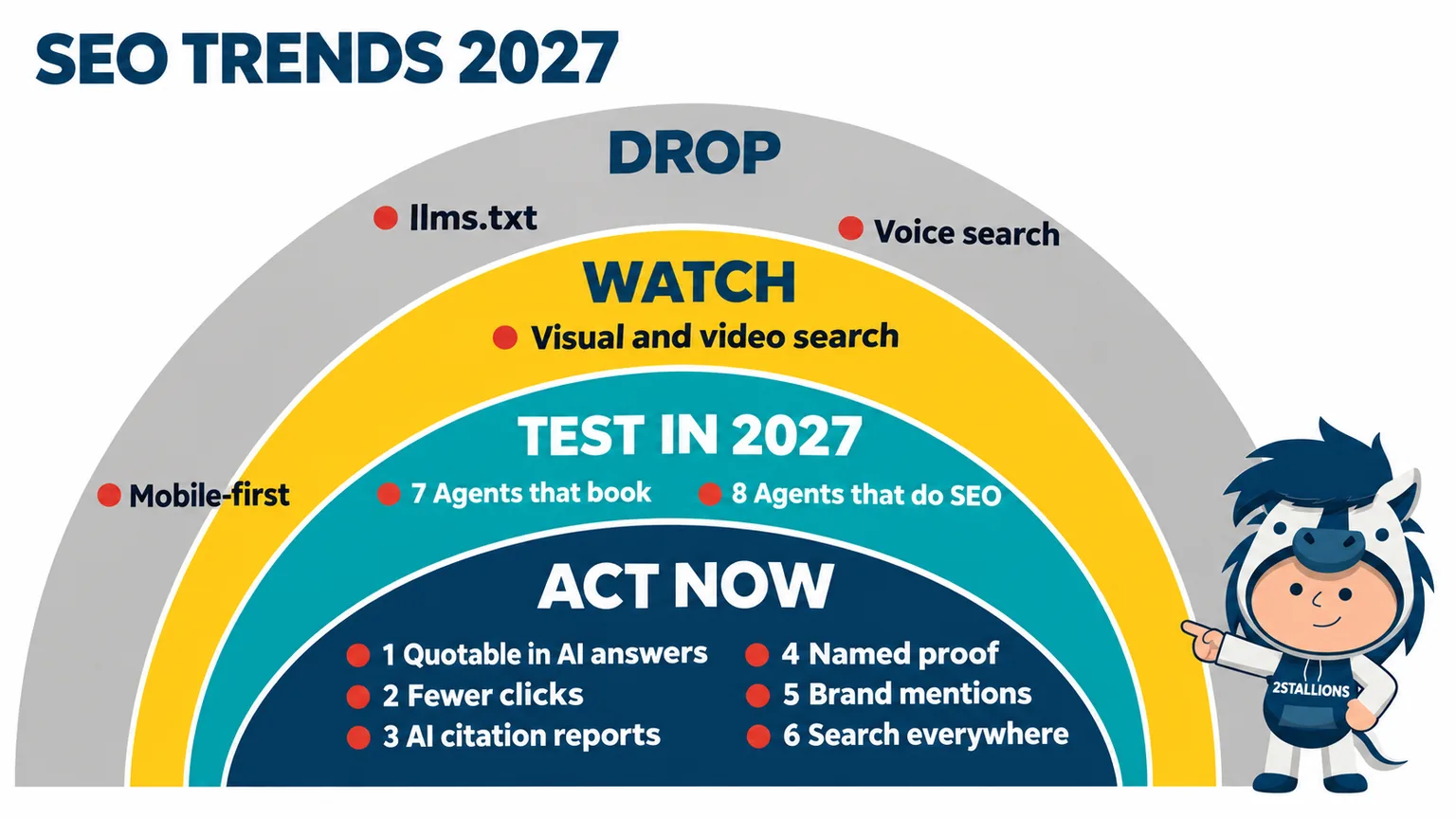
The 2027 SEO trend radar
| Ring | What it means | Trends in this ring |
|---|---|---|
| Act now | A 2026 platform report or dated study shows it today, and you can measure it. Put budget behind it. | 1. Quotable in AI answers, 2. Fewer clicks, 3. AI citation reports, 4. Named proof, 5. Brand mentions, 6. Search everywhere |
| Test in 2027 | Platforms have shipped it, but usage data is small. Run a pilot with one success measure. | 7. Agents that book, 8. Agents that do SEO |
| Watch | Real, but not measurable in your reports yet | Visual and video search |
| Drop | Not a trend of its own, so it needs no separate budget | llms.txt, voice search as a channel, “mobile-first” as a trend |
A trend sits in Act now when you can measure it today in Search Console, Bing Webmaster Tools or your analytics. Inside Act now, the order follows the work. Be quotable (1), read the new numbers (2, 3), prove who is speaking (4), then spread beyond your site (5, 6).
If you can only fund two this year, open the AI reports (trend 3). Then put a named person on every page that matters (trend 4).
The 8 SEO trends for 2027
1. AI answers sit on top of search, so every page has two jobs
Google’s documentation says there are no additional requirements to appear in AI Overviews or AI Mode[3].
What to do
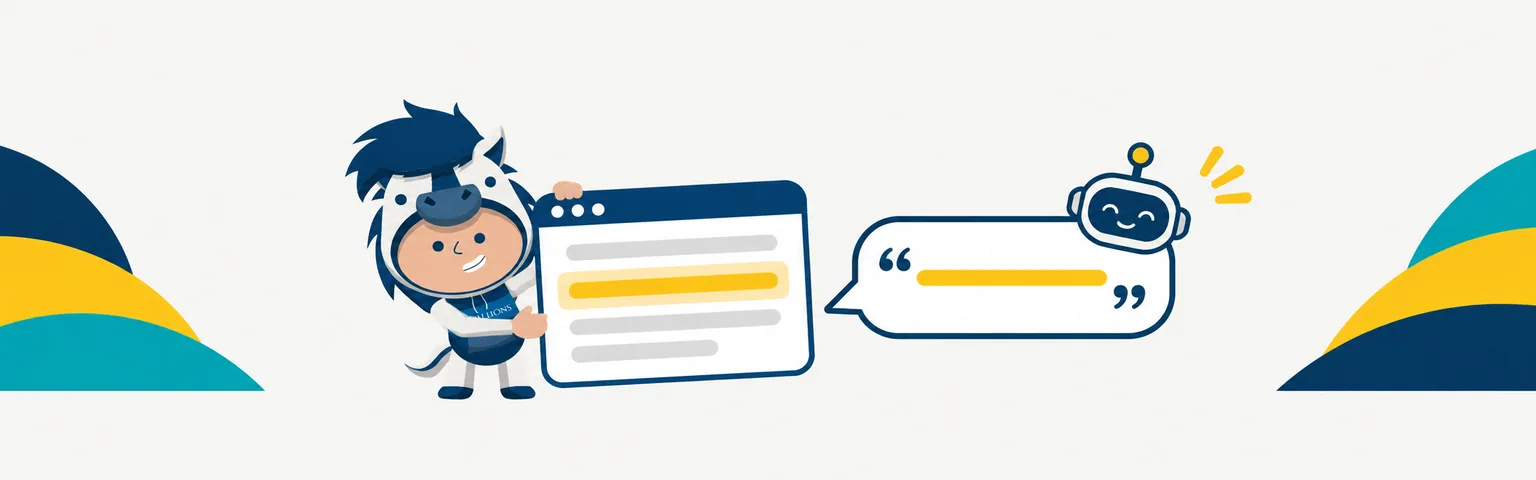
Take the pages that bring you leads. Make each one answer its main question in the first two sentences, with a date and a source. The on-site and off-site SEO guide covers the base work, and the search everywhere optimisation (SEO) service page shows how 2Stallions runs it.
Do I need to do anything special to appear in AI Overviews?
No. Google says there are no additional requirements, and no special optimisations are necessary, though all existing SEO fundamentals continue to be worthwhile[3].
The ordinary practices still apply. Let search engines crawl the page, keep important content as text, and make structured data match the visible text[3].
What kind of content do AI answers quote?
Google asks for unique, non-commodity content that your visitors and readers will find helpful[4]. Google also says clicks from results with AI Overviews are higher quality[4].
Does classic ranking work still pay off?
Yes, where the content matches what buyers ask.
A leading insurance company in Singapore saw organic sessions rise 17% year on year, to 810K. The review covered 12 months, April 2021 to March 2022[5]. Also, 37 of its 55 target keywords had reached the top 10 of Google by the end of that review[5].
That period is before AI Overviews, so it proves the base work only.
Who should act on this?
Anyone whose buyers ask questions before they call.
2. Fewer clicks for the same rankings
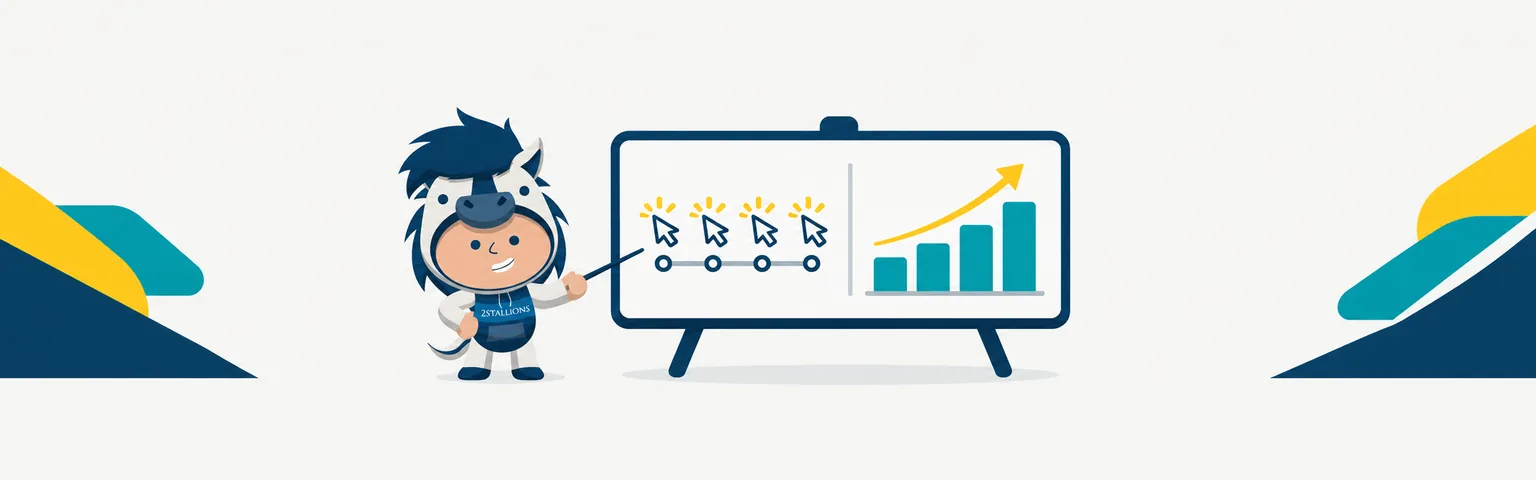
Pew Research Center found people clicked a traditional result on 8% of visits when an AI summary appeared, against 15% when it did not[6].
What to do
Add impressions and leads next to clicks in the monthly SEO report, and set the 2027 target on leads. The 2Stallions digital marketing trends for 2027 makes the same case for the whole funnel.
How should the monthly SEO report change?
Put leads and impressions at the top, and show clicks beside them. A flat click line can sit next to a healthy lead line.
At 2Stallions we review each client’s SEO and AI reports with them once a month. Inside the team we review them weekly. The work itself goes on daily, in small and steady improvements, so we know what to recommend next.
How much traffic does an AI Overview take?
Ahrefs found an AI Overview correlated with a 34.5% lower average click-through rate for the top-ranking page, in March 2025 data[7]. Its re-run on 300,000 keywords with December 2025 Search Console data put the drop at 58%[2].
These are one study at two dates. Both describe a correlation.
Do clicks inside the AI summary make up for it?
No. Pew found 1% of visits to pages with an AI summary ended in a click on a link inside the summary[6].
Who should act on this?
Teams whose SEO report starts with sessions. One limit: Pew studied 900 US adults, so check your own Search Console before you change targets.
3. AI citations get their own report
Google announced Search generative AI performance reports in Search Console on 3 June 2026[8].
What to do
Open both reports this month, note your citation share for the queries that matter most, and check it monthly beside rankings. The 2Stallions guide to how to show up in ChatGPT and Gemini covers the writing side. The hub post places this in the wider plan.
What does Search Console show for AI Overviews and AI Mode?
It shows how often URLs from your site appeared in generative AI features in Search and Discover[8]. The metric is impressions, and you can split it by page, country and date[8].
Google says it had rolled these insights out to all websites worldwide as of 31 August 2026[8].
What is citation share in Bing Webmaster Tools?
It is the percentage of citations attributed to your site out of all citations shown across all sites for a grounding query[9]. Bing defines grounding as the source material and web evidence the system uses to support and cite its response[9].
The report covers Microsoft Copilot, Bing and select partner AI experiences[9]. Bing’s AI Performance report, in public preview since February 2026, adds total citations and page-level citations[10].
Who should act on this?
Anyone who reports SEO to a boss or a client. One limit: Google’s post describes the metric as impressions, and Bing’s report is a public preview, so treat both as direction.
4. Proof from a named person beats bulk content
The Reuters Institute found 20% of people trust answers from AI chatbots, against 37% for news overall. The survey covered 48 markets[11].
What to do
Put a named author, one dated fact with a source, and one thing your team saw first-hand on every page that matters. The 2Stallions content marketing trends post shows how.
Why is original experience worth more in 2027?
Google asks for unique, non-commodity content[4].
Ahrefs’ basket of 10 information-only blogs sits at about 28% of its peak organic traffic[2].
Do Google’s core updates still matter?
Yes, as a prompt to check your own pages. Google’s dashboard lists core updates on 27 March, 21 May and 10 November 2026. Spam updates came on 24 March, 24 June, 18 August and 24 September 2026[12].
The dashboard lists dates only. After each update, compare your top pages in Search Console with the weeks before.
Who should act on this?
Service firms whose buyers choose on trust.
One limit: the Reuters figure is global and about news. The Ahrefs basket is small and unnamed. Use both as direction for a Singapore or Malaysia business.
5. Brand mentions beyond your site predict AI visibility
Ahrefs studied 75,000 brands. Branded web mentions correlated with AI visibility at 0.66 to 0.71, and YouTube mentions at about 0.74[2].
What to do
List the 10 places your buyers already read, watch or ask. Then get your brand described the same way on each, from one set of brand facts. The guide to building good backlinks covers the link work that still applies.
Why does the same brand description everywhere matter?
An AI model learns what it knows about you from how the web describes you. Ahrefs says the more a brand is talked about in relevant places, the more likely it is to show up in AI answers[2].
Who should act on this?
Brands with a PR or partnerships budget. This is a correlation, so test it on your own brand. For a Singapore or Malaysia brand, begin with the places your local buyers already use.
6. Search everywhere: your buyers search on social, video and in chatbots too
Searches for “search everywhere optimization” rose 197% year on year, in Ahrefs’ June 2026 article[2].
What to do
Find the three places outside Google where your buyers already look, such as YouTube, TikTok, Reddit and ChatGPT. Make sure your answer exists there in the platform’s own format. The 2Stallions social media trends post covers the platforms in more detail.
What is search everywhere optimisation?
It is SEO for every place your buyers search: Google, YouTube, TikTok, Reddit and AI chatbots such as ChatGPT. The 2Stallions search everywhere optimisation (SEO) service puts it this way: SEO is no longer just search engine optimisation.
How many people search in AI chatbots now?
OpenAI said ChatGPT reached 900 million weekly active users in February 2026, as TechCrunch reported[13]. Weekly use of AI chatbots for news rose from 7% to 10% across 48 markets[11].
In Singapore, 59% get news through social media and 11% through AI chatbots[14].
Does video still matter for SEO?
Yes, as support for the text. Google asks you to support your textual content with high-quality images and videos[4].
Give each video on a page a clear description and a transcript, so it adds to the page.
Who should act on this?
Consumer brands, and anyone selling to buyers under 35. One limit: the Reuters figures are about news. Use them as a sign of habit.
7. AI agents start searching and booking for people
Google expanded AI Mode to over 180 new countries and territories in English on 21 August 2025. It also began to roll out agentic features, starting with restaurant reservations[15].
What to do
Check that an agent could complete your key task on your site. Show prices, hours, availability and forms in plain HTML. The 2Stallions digital marketing trends for 2027 covers AI agents across channels.
What is agentic search?
It is search that does a task for the person, such as a booking. In Google’s example, AI Mode checks real-time availability and links the person to the booking page[15].
How would an agent read my site?
It needs facts it can read without guessing. Put prices, opening hours and availability in text on the page.
Who should act on this?
Businesses with bookings, quotes or product data. One limit: the reservations feature began as a Labs experiment for Google AI Ultra subscribers in the US[15]. A Singapore or Malaysia business should treat it as a test.
8. AI agents run SEO tasks, with a person checking
Searches for “seo ai agent” rose 285% year on year, in Ahrefs’ June 2026 article[2].
What to do
Pick one repeatable task, such as internal links, title tests or a monthly audit. Write the rules for it, and name the person who signs off.
Which SEO tasks can an agent do now?
Ahrefs lists keyword research, content updating, internal linking and site auditing among the tasks agents can now take on[2].
Who should act on this?
Teams with a backlog of routine SEO work. The rules and the sign-off matter more than the tool. Ahrefs also sells agent tooling, so start with a task you can check in your own reports.
Watch and drop
- Watch: visual and video search. Google asks for images and video that support the text on the page[4]. Fund it as part of each page.
- Drop: llms.txt. Google says you don’t need new machine-readable files, AI text files or markup to appear in these features[3]. Ahrefs found 97% of llms.txt files were never fetched in a given month[2].
- Drop: voice search as a channel of its own. Plan it inside trend 1: answer the question in the first two sentences. The 2Stallions guide to voice search SEO still covers the conversational queries.
- Drop: “mobile-first” as a trend. It is a basic need. Every page should work well on a phone.
How to act on these trends in 2027
- Open Google’s AI reports in Search Console[8] and Bing’s AI Performance report[10], and record your citation share for the queries that matter most.
- Change the monthly report: leads and impressions first, clicks beside them, and review it with the client or your boss every month.
- Fix the pages that matter most: answer the main question in the first two sentences, with a date and a source.
- Add a named person and one first-hand detail to each of those pages.
- Test one agent task with written rules and a named person who signs off.
Want to see where your site stands in AI search? Book a free AI visibility audit. The 2Stallions search everywhere optimisation (SEO) service offers it.
Which of your top pages would you still fund if it never earned a click again?
More 2027 trend reports
This guide is part of our 2027 trends series. Start with the digital marketing trends for 2027, or pick another guide below.
Content trends
Branding trends
Social media trends
Influencer marketing trends
Digital advertising trends
Google Ads trends
Web design trends
Frequently asked questions
What are the SEO trends for 2027?
Six are ready for budget now. They are being quotable in AI answers, fewer clicks, AI citation reports, proof from a named person, brand mentions and search beyond Google. Test AI agents that book and AI agents that do SEO tasks.
Is SEO still worth it in 2027 when AI answers take the clicks?
Yes, but the job changes. Rankings still earn visibility, and the goal moves to being quoted and to leads. Measure both.
What is search everywhere optimisation?
It is SEO for every place your buyers search: Google, video, social platforms, community sites and AI chatbots.
Do I need an llms.txt file?
No. Google says you don’t need new machine-readable files, AI text files or markup to appear in its AI features[3].
How do I know if AI answers cite my site?
Open the generative AI performance reports in Google Search Console, and the AI Performance report in Bing Webmaster Tools. Then check the queries that matter most each month.
Is voice search still an SEO trend?
Not as a channel of its own. Plan it inside your AI answers work by answering the question in the first two sentences.
Sources
All sources were retrieved on 11 November 2026.
- Google: Sundar Pichai, Google I/O 2026 keynote post
- Ahrefs: SEO trends
- Google Search Central: AI features and your website
- Google Search Central: Top ways to ensure your content performs well in Google’s AI experiences on Search
- 2Stallions: case study, a leading insurance company in Singapore
- Pew Research Center: Google users are less likely to click on links when an AI summary appears
- Ahrefs: AI Overviews reduce clicks
- Google Search Central: Generative AI performance reports
- Microsoft Bing: New AI visibility insights in Bing Webmaster Tools
- Microsoft Bing: AI Performance in Bing Webmaster Tools, public preview
- Reuters Institute: Digital News Report 2026, executive summary
- Google Search Status Dashboard: ranking updates history
- TechCrunch: ChatGPT reaches 900M weekly active users
- Reuters Institute: Digital News Report 2026, Singapore
- Google: AI Mode agentic and personalized features