

Search engine marketing (SEM) results can shift without anyone touching the account. A Google Ads campaign that beat its target cost per action (CPA) in July and missed it in September didn’t break. Since 17 August 2026, Google has updated its bidding systems, so campaigns that are limited by budget and use a target-based bid strategy perform more consistently[1].
Demand isn’t the problem. Google’s Search and other revenue rose 12% in the third quarter of 2026, and the company said its year-over-year query growth was the highest in five years[2]. What changed is who makes the decisions inside the account. Google and Microsoft now handle more of the bidding, the matching and the ad copy.
Below are seven trends on one radar, each with what to do first and then the dated evidence. They cover search ads only. For display, video and retail media, see the digital advertising trends post.
Why search ads change in 2027: the platforms bid, you decide what a lead is worth
Search still grows, but the levers moved from the keyword tab to your targets and your tracking. Google’s e-Conomy SEA 2026 report, with Temasek and Bain & Company, puts online media revenue in Southeast Asia at US$44 billion, up 22%[3]. The platforms decide how to bid, so you decide what a lead is worth and what you send back. The digital marketing trends for 2027 post makes the same case across every channel.
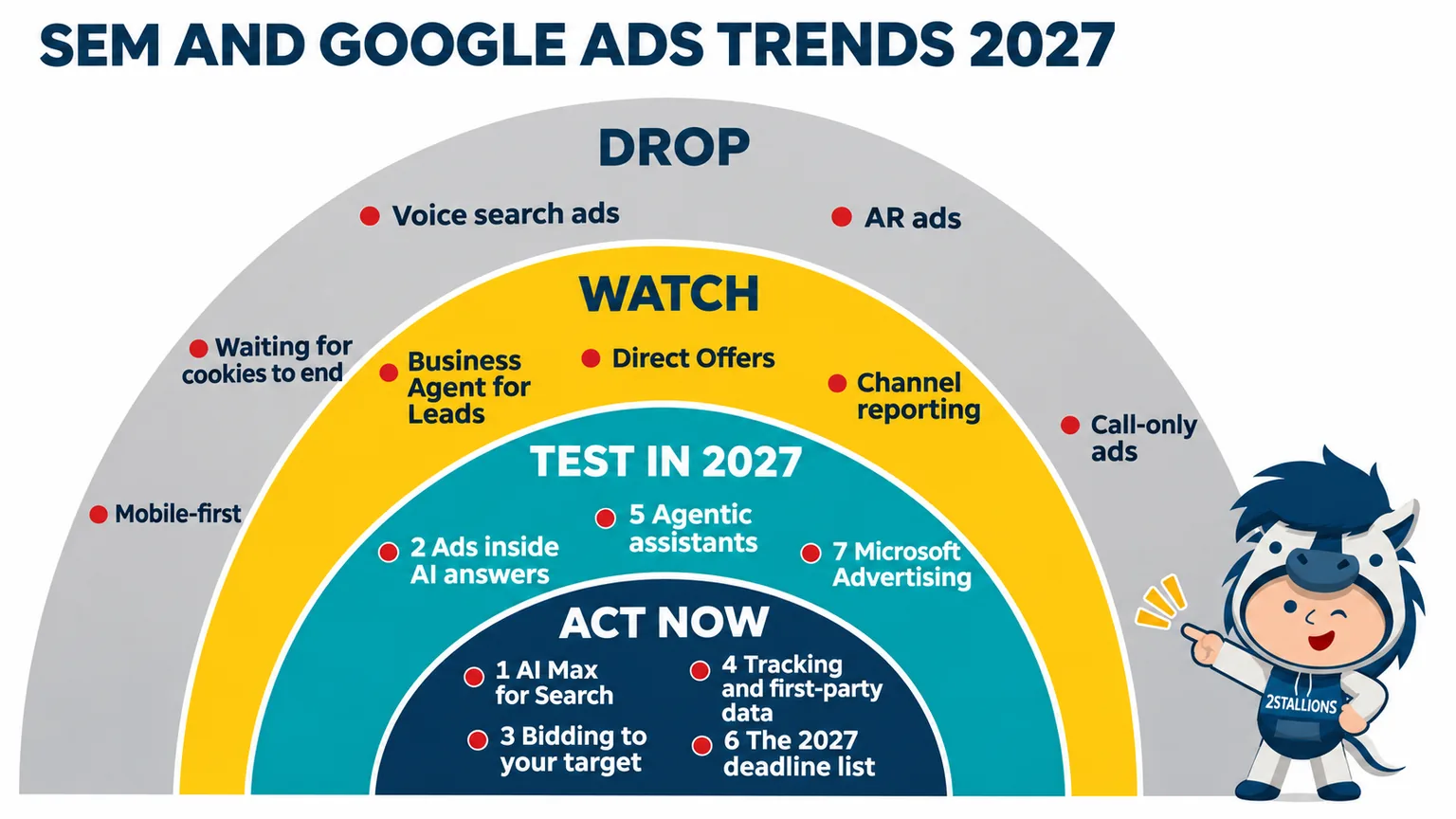
The 2027 SEM trend radar
| Ring | What it means | Trends in this ring |
|---|---|---|
| Act now | Shipped to all advertisers, with dated evidence or a dated deadline. Put effort behind it. | 1. AI Max for Search, 3. Bidding to your target, 4. Tracking and first-party data, 6. The 2027 deadline list |
| Test in 2027 | Live, but in pilot, in beta or new to the region. Run a capped test with a clear measure. | 2. Ads inside AI answers, 5. Agentic assistants, 7. Microsoft Advertising |
| Watch | Announced, but early for most budgets | Business Agent for Leads; Direct Offers; channel reporting for Search and Shopping |
| Drop | Stop planning around it as a trend | Voice search ads as a separate tactic; augmented reality ads; waiting for third-party cookies to end; “mobile-first” as an SEM trend; call-only ads and keyword-only structures |
A trend is in Act now when the platform has shipped it to all advertisers and there is dated evidence of results, or a dated deadline forces it. It is in Test when it is live but in pilot, in beta or new to Singapore and Malaysia. Inside Act now, the order follows how much of the account the change touches: campaign type, then bidding, then data, then deadlines.
If you can only fund two this year, start with trend 3 (reset your targets) and trend 4 (send lead quality back). Neither needs more media budget.
The 7 SEM and Google Ads trends for 2027
1. AI Max for Search becomes the default Search campaign
From February 2027, Google upgrades campaigns that use Dynamic Search Ads (DSA) to AI Max for Search automatically[4], and campaign-level broad match and automatically created assets have been upgrading since September 2026[5].
What to do
Is AI Max mandatory in 2027?
Not as a separate campaign type, but the upgrades are automatic. AI Max is a set of features on your existing Search campaigns[6]. Google upgrades DSA campaigns from February 2027[4], and you can still adjust the individual features[6].
What does Google say AI Max does to results?
Google says AI Max for Search campaigns see an average of 7% more conversions or conversion value at a similar CPA or return on ad spend (ROAS)[5]. That’s Google’s own 2026 data, for non-retail advertisers. Treat it as a hypothesis, and test it on your own account.
Does Microsoft have the same feature?
Yes. Microsoft announced on 27 August 2026 that AI Max for Search is available to all advertisers[7]. In early tests, advertisers saw at least an 8% increase in conversions, in an analysis of 44 A/B experiments that kept bid strategy and campaign budget the same[7]. If you’re using Google Import, AI Max settings can now be carried over from Google Ads[7]. Read the 8% as a reason to test in a Singapore or Malaysia account.
Who should act on this?
Any account still running DSA, campaign-level broad match or automatically created assets. One limit: final URL expansion can send paid traffic to old or weak pages, so clean the site or exclude those URLs first. The guide to keyword match types shows how broad match behaves.
2. Ads move inside AI answers, on Google, Microsoft and ChatGPT
Google announced in May 2026 that it is testing Conversational Discovery ads and Highlighted Answers in AI Mode, clearly labelled “Sponsored”[8].
What to do
Build the foundation Google names for the new formats, which is AI Max for Search, AI Max for Shopping and Performance Max[8]. Then budget one capped test, with its own budget line and a lead-quality measure, and look at how the “Sponsored” placement appears before you buy.
Where do ads show in Google’s AI answers?
Mostly in tests for now. AI Overviews has over 2.5 billion monthly active users and AI Mode has passed 1 billion[9]. Google says it is launching AI-powered Shopping ads, and that in the coming months it is bringing two new ways to give people real-time product advice on Search[8]. In a survey Google commissioned from Ipsos in December 2025, 75% of 13,189 online shoppers in 25 countries who use AI Overviews or AI Mode for shopping said they make faster, more confident decisions using AI Mode[8]. Read that as Google’s claim across 25 countries. Test it in your own Singapore or Malaysia account.
Can a Singapore or Malaysia business advertise in ChatGPT?
Yes. PPC Land reports that OpenAI announced on 23 September 2026 that ChatGPT Ads were rolling out to seven Asian markets, including Singapore and Malaysia[10]. Ads show only to users on the Free and Go plans[10]. You can buy through OpenAI’s sales team, a partner or the self-service Ads Manager, and access depends on where the buyer is incorporated. Where the audience sits does not decide it[10].
What about Microsoft Copilot?
Don’t count on Copilot reach yet. In its June 2026 post, Microsoft says “AI Max and PMax are the most effective ways to make sure you’re capturing relevant intent”[11]. The post doesn’t say that ads serve on Copilot surfaces, so check where your ads show first.
Who should act on this?
Lead-generation businesses whose buyers research before they enquire. One limit: the clicks that remain are fewer when an AI summary appears. Pew found users clicked a result link in 8% of visits with a summary and 15% without one, in a March 2025 study of 900 adults in the United States[12]. Pew’s figures come from the United States, so treat them as a direction for Singapore and Malaysia.
3. Smart Bidding now spends to the target you set
Since 17 August 2026, Google has updated its bidding systems, so campaigns that are limited by budget and use a target-based bid strategy perform more consistently[1].
What to do
Filter your campaigns by “Limited by budget”. Compare the real CPA of the last 90 days with the target you typed. Then lower the target to the number you mean, knowing a lower target can cut volume. Google won’t change your targets or budgets for you[1].
Why did my CPA go up after August 2026?
Most likely because Google now spends up to the target you typed. Google’s own example is a Target CPA of US$10 that had been achieving US$5[1]. App, Video reach and Video view campaigns keep their previous bidding behaviour[1]. A higher CPA after that date isn’t a failed campaign. Check the target first, then decide whether to keep it, lower it or switch strategy.
Which bidding features are worth turning on?
Start with the ones tied to leads. Google says Search campaigns using Smart Bidding Exploration see 27% more unique converting users on average, based on its own data for Search text ads from 1 January to 20 February 2026[13]. That isn’t a Singapore or Malaysia figure, so check it in your own account. Journey-aware bidding, in beta, learns from phone calls, form submissions and newsletter sign-ups[13]. Campaign total budgets cut manual budget adjustments by 66% on average, Google says[13].
Who should act on this?
Every account with a target-based bid strategy and a budget that runs out.
4. Conversion tracking and first-party data decide what the AI optimises toward
Google confirmed in April 2025 that Chrome keeps its current approach to third-party cookie choice and won’t roll out a new standalone prompt[14].
What to do
Define a qualified lead, then send it back to the ad account through offline conversions, enhanced conversions or your CRM (the system that holds your client records), so journey-aware bidding can learn from it[13]. The guide to Google Analytics for search engine marketing covers the setup.
What does good tracking look like in practice?
It follows a lead from click to sale. In a 2Stallions case study, every lead for a US healthcare compliance software provider was attributed to its platform, campaign and keyword, and qualified within seven days of entering the funnel[15]. Over three months, leads rose 45% (1,155 more), cost per lead fell 28% and return on ad spend reached 723%[15].
That programme began with search, display and social ads, so it shows what tracking makes possible. It says nothing yet about AI Max. Read the case study.
A fixed date makes the measure plain. On Google Ads, we ran lead generation for an education institute and sold out its event two weeks before the due date, under budget.
Do I still need to plan for the end of third-party cookies?
No. Chrome keeps third-party cookie choice[14], so waiting for cookies to die isn’t a plan. The trend is the data you own: your tracking, your CRM and your consent records. Check the privacy rules for your market, and ask a legal adviser about the details.
Who should act on this?
Any business whose leads close offline or weeks later. A low cost per lead means little if the sales team can’t close those leads. Tracking fixes take developer time, so book it before the February deadlines in trend 6.
5. Agentic assistants join the ad account, and a person still approves
Google’s Ask Advisor, built on Gemini, is in beta and makes suggested changes once you approve them[16].
What to do
Use the assistant for root-cause questions and tracking checks, then compare its suggestion with your own 90-day data before you approve.
What can Ask Advisor do today?
It can identify areas for improvement, troubleshoot and apply changes with your approval, and it isn’t available in manager accounts[16]. Google announced it as Ads Advisor in November 2025, coming to English-language accounts that December[17]. At Google Marketing Live in May 2026, it described one Gemini agent across Google Ads, Google Analytics, Merchant Center and Google Marketing Platform[18].
What does Microsoft’s Copilot do in the ad platform?
Microsoft says Copilot in the Advertising Platform explains why performance spiked or dropped, and checks that your Universal Event Tracking (UET) tags and conversion goals are set up correctly[19].
Who should act on this?
Teams without a dedicated analyst. One limit: an assistant optimises for what it can see. It can’t see whether a lead became a client unless you send that back (trend 4).
6. Google tidies the account: the deadlines you cannot skip
Google stopped supporting new call-only ads in January 2026, and existing ones stop serving in February 2027[20].
What to do
Put the dates below in the team diary, with one named owner for each.
- Call-only ads: existing ones stop serving in February 2027[20]. Replace them with responsive search ads that use call assets.
- Smart campaigns: new ones can’t be created from 23 September 2026[20]. Plan standard Search campaigns instead.
- Language targeting: no longer supported for Search, AI Max for Search and Performance Max on Google Search from September 2026. Ads match on the language of your ads and landing pages[20]. An account that runs English, Malay and Chinese needs ads and pages in each language.
- Dynamic Search Ads: upgraded to AI Max from February 2027 (trend 1)[4].
Which deadlines hit a Singapore or Malaysia account first?
Smart campaigns went first, on 23 September 2026, and language targeting followed in September 2026[20]. Language targeting matters most for accounts that reach English, Malay and Chinese speakers, because each language now needs its own ads and pages. Call-only ads and Dynamic Search Ads follow in February 2027[20][4].
Where do I check for the next change?
Start with Google’s own help pages and the Google Ads API deprecations page[20]. Read the live page in the week you act.
Who should act on this?
Anyone with call-only ads, Smart campaigns or multilingual targeting.
7. Microsoft Advertising earns a test next to Google
Microsoft announced on 27 August 2026 that AI Max for Search is available to all Microsoft Advertising advertisers[7].
What to do
Import one proven Google Search campaign with Google Import, keep the same conversion goals, and compare cost per qualified lead after 30 days.
What is new in Microsoft Advertising for 2027?
Microsoft says advertisers using its Performance Max see an average 8% increase in incremental conversions, based on its own global data from September 2024 to September 2025[19]. It has also added new customer acquisition goals and announced a pilot of term exclusions[19]. LinkedIn profile targeting for job seniority is in pilot in the United States and Canada[19], so don’t plan around it in Singapore or Malaysia yet. The 8% is Microsoft’s global figure, so test it on one campaign first.
Why test Microsoft next to Google?
A small test shows how your own leads respond on a second search engine. Microsoft’s own case, in its June 2026 post, is that “AI Max and PMax are the most effective ways to make sure you’re capturing relevant intent”[11].
Who should act on this?
B2B and professional services advertisers whose buyers work on Windows and Edge.
Watch and drop
- Watch: Business Agent for Leads. Google describes a chat agent inside the ad, due in the coming months[8]. Wait for results before you fund it.
- Watch: Direct Offers. Google has piloted them since January 2026[8]. For retail, see the digital advertising trends post.
- Watch: channel performance reporting for Search and Shopping. It is live for Performance Max and Demand Gen, and extends to Search and Shopping campaigns in 2027, with no month given[21].
- Drop: voice search ads as a separate tactic. Plan for voice as part of ads inside AI answers (trend 2).
- Drop: augmented reality (AR) ads as a search trend. The focus here is search ads; the digital advertising trends post covers other formats.
- Drop: waiting for third-party cookies to end. Chrome keeps third-party cookie choice[14]. Build first-party data instead (trend 4).
- Drop: “mobile-first” as an SEM trend. It’s a basic need now. The search everywhere optimisation (SEO) trends post covers it.
- Drop: call-only ads and keyword-only structures. Call-only ads stop serving in February 2027[20], and AI Max adds search term matching on top of your keywords[6].
How to act on these trends in 2027
- Reset your targets. Filter by “Limited by budget”, compare the last 90 days of real CPA with the target, and set the target you mean (trend 3).
- Fix your tracking. Define a qualified lead and send it back to the ad account (trend 4).
- Run Google’s one-click AI Max experiment with brand and URL exclusions, and judge it on cost per lead (trend 1).
- Budget one capped test for ads inside AI answers, with a lead-quality measure (trend 2).
- Diary the 2027 deadlines, and check Google’s live pages the week you act on them (trend 6).
Want to understand where your advertising budget could perform better? Speak with our team about a paid media audit.
If you want help with the work above, see our search engine marketing service and our Google Ads service.
Which of your campaigns is still chasing a target you set two years ago?
More 2027 trend reports
This guide is part of our 2027 trends series. Start with the digital marketing trends for 2027, or pick another guide below.
Content trends
Branding trends
Social media trends
SEO trends
Influencer marketing trends
Digital advertising trends
Web design trends
Frequently asked questions
What are the Google Ads trends for 2027?
Seven stand out. Four are ready to fund now: AI Max for Search as the default Search campaign, bidding that spends to your target, tracking that carries lead quality back, and the 2027 deadline list. Three are tests: ads inside AI answers, agentic assistants and Microsoft Advertising.
What is search engine marketing (SEM), and how is it different from SEO?
SEM is paid search: you bid for your ads to appear on search results. Search everywhere optimisation (SEO) earns unpaid visibility instead. Most businesses need both. The guide to SEO vs SEM explains how to choose.
Is voice search still a Google Ads trend?
No. Plan for voice as part of ads inside AI answers (trend 2).
How much do Google Ads cost?
LocaliQ’s 2026 search advertising benchmarks put the average cost per click at US$5.42 and the cost per lead at US$66.69 across Google Ads and Microsoft Ads data[22]. Those are US dollars with no country given, so treat them as a rough guide for a Singapore or Malaysia budget. For local figures, read the guide to Google Ads cost in Singapore.
Sources
All sources were retrieved on 11 November 2026.
- Google Ads Help: Changes to target based bid strategies
- Alphabet Inc.: Q3 2026 earnings release (Form 8-K exhibit 99.1)
- Google, with Temasek and Bain & Company: e-Conomy SEA 2026, Southeast Asia’s digital economy
- Google Ads Help: About Dynamic Search Ads
- Google Ads & Commerce blog: Google’s Dynamic Search Ads are upgrading to AI Max
- Google Ads Help: How AI Max for Search campaigns works
- Microsoft Advertising blog: AI Max for Search is now available
- Google Ads & Commerce blog: A new generation of ads for the AI era of Search
- Google: Sundar Pichai at I/O 2026
- PPC Land: OpenAI gains 7 Asian markets for ChatGPT ads, passing 60 countries
- Microsoft Advertising blog: Building a new AI economy that creates value for everyone
- Pew Research Center: Google users are less likely to click on links when an AI summary appears in the results
- Google Ads & Commerce blog: Google Marketing Live 2026, bidding and budgeting news
- Google Privacy Sandbox: Next steps for Privacy Sandbox and tracking protections in Chrome
- 2Stallions: case study, 1,155 B2B leads at 28% lower cost
- Google Ads Help: Ask Advisor in Google Ads (beta)
- Google Ads & Commerce blog: Google’s AI advisors, agentic tools to drive impact and insights
- Google Ads & Commerce blog: Google Marketing Live 2026, news and announcements
- Microsoft Advertising blog: An ads ecosystem built for the AI era
- Google Ads API: Feature deprecations and unversioned changes
- Google Ads Help: Evaluate Performance Max results
- WordStream by LocaliQ: Google Ads benchmarks 2026