Content
SHARE
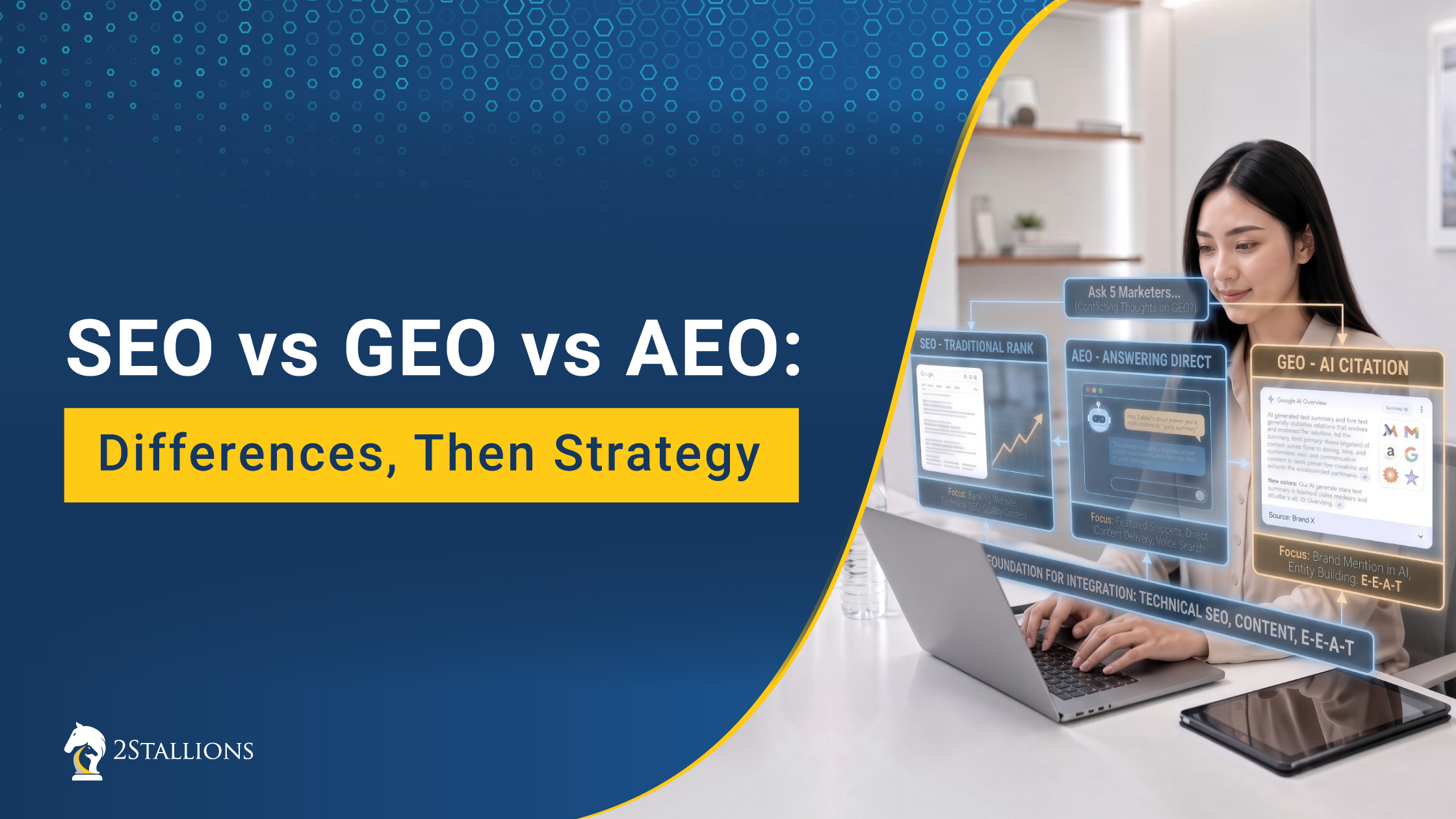
Ask five marketers what GEO means and you might get five different answers. Some call it the new SEO. Others see it as a passing trend. But the way people search is already changing. Customers are asking ChatGPT for recommendations, using Google’s AI Overviews for quick answers, and still turning to Google to research brands before making a decision.
SEO still matters, but it is no longer the only way to get found. Brands now need to consider how they appear across traditional search and AI-powered platforms.
Here’s a clear breakdown of SEO, AEO, and GEO, how they differ, and how to bring them together into one search strategy.
How People Actually Search Today
A few years ago, the customer journey was fairly linear. Someone had a need, typed a few words into Google, browsed three or four websites, and made a decision. SEO was built almost entirely around winning that one moment: the click from the search results page.
That journey has splintered. A typical buyer today might ask ChatGPT or Gemini a broad, conversational question first, something like “what’s the best way to do X”, rather than typing keywords into Google. They turn to Google once they are ready to compare specific options, read reviews, or find a local provider. Then they check Reddit, Quora, YouTube, or Google Reviews to validate a shortlist before committing.
Each of these moments is won or lost by a different discipline, which is exactly why SEO alone no longer covers the whole journey.
Google Isn’t Dead, It’s Just Not Alone Anymore
The confusion around SEO, GEO, and AEO is not hypothetical. It shows up directly in search data. Terms like “AI SEO,” “Generative Engine Optimisation,” and “SEO vs GEO” are searched thousands of times a month globally, and volume has climbed steadily through 2026 as more marketers try to make sense of what has actually changed.
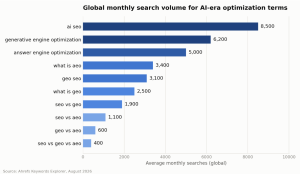
Global monthly search volume for AI-era optimisation terms. Source: Ahrefs Keywords Explorer, August 2026.
Part of the confusion comes from Google’s AI Overviews, which now appear on a large share of searches and often answer the question directly above the organic results, before a user ever scrolls down to a traditional listing. Ranking on page one is still valuable. It is just no longer the only, or even the first, moment where visibility gets decided.
Defining SEO, AEO, and GEO
Here is a simple way to think about all three:
- SEO (Search Engine Optimisation): the practice of ranking on Google and Bing’s organic results pages.
- AEO (Answer Engine Optimisation): the practice of getting content extracted as the direct answer, in featured snippets, People Also Ask boxes, voice search results, and AI Overviews.
- GEO (Generative Engine Optimisation): the practice of getting a brand cited as a trusted source inside AI-generated responses from ChatGPT, Gemini, Claude, and Perplexity.
In short, SEO is about ranking, AEO is about being the answer, and GEO is about being the source the AI cites.
| SEO | AEO | GEO | |
| Goal | Rank on Google’s first page | Be extracted as the direct answer | Be cited as a source by AI |
| Primary channels | Google, Bing organic results | Featured snippets, People Also Ask, AI Overviews, voice search | ChatGPT, Gemini, Claude, Perplexity |
| Content format | Long form, keyword structured pages | Concise 40 to 60 word answers, clear headers, FAQ schema | Authoritative, well cited, consensus backed content |
| Success metric | Rankings, organic traffic, CTR | Snippet or answer capture rate | Citation frequency, AI referral traffic |
A side-by-side look at what each discipline optimises for.
SEO vs AEO vs GEO: Why They’re Not Competing Strategies
It is tempting to treat SEO, AEO, and GEO as three separate budgets or three separate teams. In practice they overlap more than they diverge. The technical SEO foundations most brands already have, like crawlable pages, fast load times, structured data, authoritative backlinks, and genuinely useful content, are the same signals that improve the odds of being extracted as an answer and cited by an AI model.
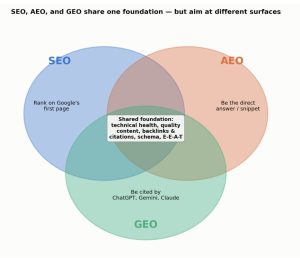
SEO, AEO, and GEO share one foundation, but each aims at a different search surface.
Skipping straight to GEO without solid SEO in place rarely works, since AI models still lean heavily on traditional search rankings and established authority when deciding what to cite. A complete organic strategy heading into 2027 means building all three on top of one shared foundation, not choosing between them.
SEO vs AEO vs GEO: What Each One Actually Looks For
SEO Ranking Factors
- Quality content and engagement signals, including time on page, scroll depth, and bounce rate
- Backlinks and domain authority from reputable, relevant sites
- Technical SEO foundations: site speed, crawlability, mobile experience, and a clean link profile
- Consistent brand mentions across the web, including social platforms and press
AEO Signals
- Content structured to answer one clear question per section, in 40 to 60 words
- FAQ schema markup and a clean heading hierarchy (H2/H3) that AI crawlers can parse easily
- Direct, conversational phrasing that mirrors how people actually ask questions
- An existing presence in featured snippets or People Also Ask boxes
GEO Signals
- Entity authority: clear expertise, credentials, and a named, credible author (E-E-A-T)
- Third-party citations and mentions across Reddit, Quora, industry publications, and review platforms
- Consensus, meaning multiple independent, reputable sources saying the same thing about a brand
- Structured data (schema markup) that helps AI systems correctly identify who a business is and what it does
How Much Should You Invest in Each?
There is no universal split. The right mix depends on how customers actually search and buy.
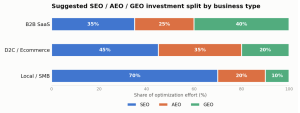
A general starting guideline. Adjust based on your own funnel data and competitive landscape.
- Local and SMB businesses still lean heavily on SEO. Local pack rankings and Google Business Profile optimisation drive most of the value, since AI platforms have less to say about hyper-local services.
- Direct-to-consumer (D2C) and ecommerce brands need a more even split, since product research increasingly starts in AI chat but purchases still happen through search and site visits.
- B2B SaaS brands should weigh GEO the heaviest. Buyers frequently ask AI tools to shortlist or compare software before ever visiting a vendor’s site.
The New Buyer Journey Spans All Three
A modern buyer rarely finishes their journey inside a single search surface. Knowing which discipline matters at which stage helps decide where to invest first.
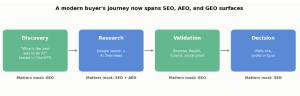
Each stage of the journey favours a different optimisation discipline.
In practice, a brand that only optimises for the decision stage, meaning its own website, may never show up during discovery or validation, where GEO-driven visibility increasingly decides who makes the shortlist at all.
Building One Strategy That Covers SEO, AEO, and GEO
SEO, AEO, and GEO work best when they are part of one strategy. Focus on these five areas:
- Get your SEO foundation right
Improve site speed, mobile experience, crawlability, and backlinks. A strong technical foundation supports everything else. - Make content easy to find and answer
Use clear H2s and H3s, answer questions directly, and keep key answers concise. Add FAQ schema where relevant. - Build authority beyond your website
Get your brand mentioned on Reddit, Quora, industry publications, and relevant review sites. These mentions can also help with AI visibility. - Use schema to help AI understand your brand
Add relevant schema such as Organization, Article, FAQ, and Product markup. This gives search engines and AI systems clearer information about your business and content. - Track more than rankings
Monitor branded search growth, AI referral traffic, and whether your brand appears in AI-generated answers for important topics.
The goal is simple: make your brand easy to find, understand, and trust across both search engines and AI platforms. That’s where the right SEO and GEO strategy can make a difference.
Looking for a trusted SEO/GEO agency? 2Stallions’ modern SEO framework is designed to boost your visibility on both search engines and AI platforms. Speak to our expert team for a free, no-strings-attached site audit and consultation.
Common Mistakes to Avoid
A strong SEO, AEO, and GEO strategy requires ongoing effort. Avoid these common mistakes:
- Chasing every new AI trend
Focus on strategies that improve your content, authority, and search visibility instead of chasing every new tactic. - Publishing AI content without human expertise
Use AI to speed up content creation, but add expert input to keep content accurate, useful, and trustworthy. - Focusing only on your website
Reviews, industry publications, discussions, and third-party mentions also shape how search engines and AI platforms understand your brand. - Treating SEO and GEO as a one-time project
Search and AI platforms keep evolving. Review your content and performance regularly and adjust your strategy accordingly.
Putting It All Together
SEO, AEO, and GEO work best as one connected strategy. Build a strong SEO foundation, create content that answers your audience’s questions, and strengthen your brand authority across search engines and AI platforms.
Search is evolving quickly, and brands that adapt across all three areas will be better positioned to stay visible and relevant.
The goal is simple: build a brand that search engines and AI platforms can easily find, understand, and trust.
FAQ:
A strong SEO, AEO, and GEO strategy requires ongoing effort. Avoid these common mistakes: